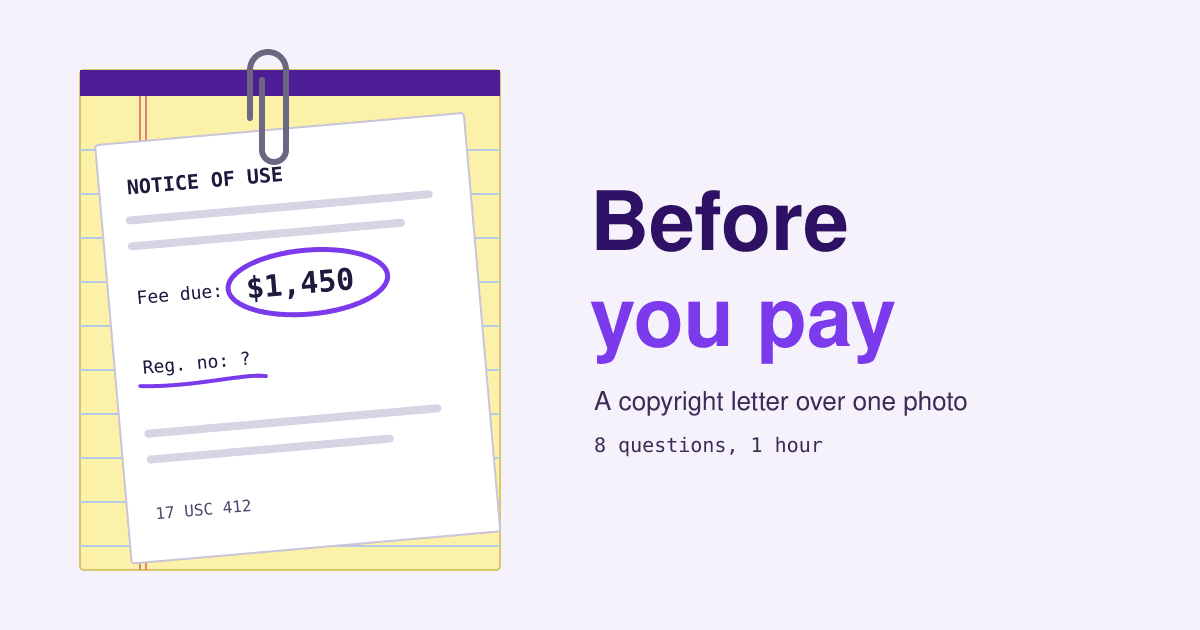
Before you pay, reply or delete anything, take screenshots of the page the letter names, with the date and the address bar showing, and save the letter itself.
Then give the letter one calm hour. A real claim does not get worse while you check it, and a fake one only works if you act fast. The eight questions below are the ones a website owner usually asks in that hour, in the order worth asking them, with the short answer first.
Check the sender exists without using the letter's own links. Find out where the picture came from and look for your licence. Take it down after the screenshots, since credit or removal does not erase past use. Look up whether the photo was registered with the US Copyright Office before you used it, because that decides whether the big statutory numbers are on the table in a federal court. Then reply in writing, briefly, asking for proof, or pay a fair licence fee if the claim holds. If a formal claim is filed, read the deadline on it the same day.
This covers US law in plain terms. It is general information, not legal advice; for a large demand or a lawsuit, talk to a copyright lawyer where you are.
Is this letter real, or a scam dressed as one?
Short answer Test the sender before you test the claim: a demand for a link instead of money or removal is the clearest sign of a fake.
Two kinds of letter look alike at first glance. Real ones come from photographers, picture agencies, law firms or companies that hunt for their clients' images online and collect licence fees. Fake ones borrow the same words for a different goal.
- The backlink trick. The email says you used a client's image and offers to drop the matter if you add a credit link to a certain website. Kaspersky described the scheme in 2023, and Search Engine Land reported senders posing as law firms with machine-made lawyer photos. A copyright owner wants payment or removal; a link pays nobody.
- The attachment trick. "See the infringing images in the attached file" with a zip or an odd download link. Do not open it. A real sender will tell you the page address and show the picture in the email itself.
- The unverifiable firm. Search for the firm and its lawyer by name in your own browser, not through the letter. A US lawyer is listed with a state bar; a firm that exists only as a fresh website and a Gmail address is not a firm.
A real letter names the exact page on your site, shows the picture, names the owner, and asks for money, removal or both. That alone does not make the price right; it only means the next seven questions are worth your time.
Is it really my picture, and where did it come from?
Short answer Find the exact file on your site, then find its paper trail: a licence receipt, a designer's handover, a free-photo site, or nothing.
Open the page the letter names and confirm the picture is there, or was. Then work out how it got there. Most owners did not choose the photo by hand, so ask whoever built the site.
- Bought from a stock library. Log in and check your download or licence history. The receipt, the licence type and the account name are your answer to the whole letter.
- Supplied by a designer or a theme. Ask the designer for the licence. Demo images bundled with a theme are often for the demo only.
- From a free-photo site. Save the page that showed the licence, with its date. Free sites change terms and remove photos; a screenshot from the day you took it is evidence.
- Copied from a search result or another site. Then there is probably no licence. A search engine shows where a picture is, never who may use it.
Run a reverse image search (TinEye or the camera icon in Google Images) to find the original and its owner. If the original sits on a stock library under the same photographer's name the letter gives, the claim is very likely real.
If I credit the photographer or take the picture down, does it go away?
Short answer No. Credit is not permission, and removal stops new use but not the claim for past use.
Taking the picture down after your screenshots is still the right move: it stops the use from running on, and it shows good faith. But the claim covers the time the picture was up, and the owner has three years after the claim accrues to sue in federal court. Do not count those years from the day the picture went up: many courts start the clock when the owner found the use, or reasonably should have, so an old picture is not a safe one. A credit line under the photo helps nobody either, unless the licence asked for one: a Creative Commons licence, for example, needs the credit as one of its terms.
Replace the picture with one you own or have a receipt for, so the page does not break, and keep the old file and its page address in a folder with the letter.
What can they actually claim under US law?
Short answer Either their real loss or a fixed amount the law sets per work, and the fixed amount depends on registration.
The owner chooses between two kinds of money under 17 U.S.C. 504. The letter's figure is a price they hope you pay, not what a court would award.
| What they may claim | Range | When it applies |
|---|---|---|
| Actual damages and your profits | What they lost | Always available. For a photo this is often measured by the fee a licence would have cost. |
| Statutory damages | $750 - $30,000 per work | In federal court, only if the photo was registered in time (question 5). Counted per photo, not per page or per day. The small claims board has lower caps of its own (question 8). |
| Statutory, wilful | Up to $150,000 per work | When a court finds you knew you had no right to use it. |
| Statutory, innocent | Down to $200 per work | When a court finds you did not know and had no reason to believe it was infringing. |
| Lawyer's fees | Their legal bill | A court may order the loser to pay them (section 505), but only with registration in time. |
That table is why letters quote round four-figure sums: they sit well under a statutory award and well over a licence, in the space where paying feels cheaper than finding out.
Was the photo registered before I used it?
Short answer Look it up yourself: no registration before your use (or within three months of the photo first being published) means no statutory damages and no lawyer's fees in federal court; the small claims board in question 8 can still award a capped amount.
Section 412 is the line most worth reading in the whole Act for anyone holding one of these letters. In a federal court, statutory damages and lawyer's fees are off the table if your use began before the photo's registration took effect, unless the photo was registered within three months of its first publication.
- Ask the sender for the registration number and its effective date. A real claimant has it or knows it does not exist.
- Search the Copyright Office's public records by that number, the photographer's name or the title.
- Compare the effective date with the day the picture went up on your site. Your screenshots, an old page in a web archive, or the file date in your site's media library can show that day.
Registered late or not at all, the owner is left in federal court with actual damages: in most photo cases, about what a licence would have cost. That number is usually far smaller than the one in the letter, and it is the honest basis for an offer. The one exception is the Copyright Claims Board (question 8): there a late-registered photo can still bring statutory damages, capped at $7,500 per work and $15,000 per proceeding.
Could my use be fair use?
Short answer Rarely for a business website using a photo as decoration, so do not build your reply on it without a lawyer.
Fair use weighs four factors: the purpose of the use, the nature of the work, how much was used and the effect on the market for it. Commentary on the photo itself, criticism or news reporting about it can qualify. A whole stock photo used to make a service page look nicer usually fails the first and last factors: it does the same job the licence was sold for, and it replaces a sale.
My web designer put it there. Is that my problem?
Short answer Yes, the site is yours, so the claim is aimed at you; whether the designer pays you back depends on your contract.
The owner can go after the site that published the picture. Read your design contract for a clause where the designer promises the content is licensed and covers your costs if it is not (an indemnity). Without one, you can still ask; many designers would rather pay a licence than lose a client.
The safe harbour in section 512 of the copyright law protects a site from what its users upload, such as forum posts or reviews, and only if it has a takedown agent registered in the Copyright Office's agent directory. It does not cover pictures that you or your designer put on your own pages.
What do I write back, and what if they file a claim?
Short answer A short written reply that asks for proof and admits nothing; if a claim arrives through the Copyright Claims Board, you have 60 days to decide whether to take part.
Reply in writing, from your business address, without the history of how the picture got there. Pick the draft that fits, fill in the brackets, and keep a copy.
Re: [their reference number]

We have checked the image at [page address].
It was licensed on [date] from [source],
licence [number]. A copy of the receipt is attached.
Please confirm the matter is closed.

[Name], [business]Re: [their reference number]
The image at [page address] was removed on [date].
Before we discuss payment, please send:
1. the owner's name and your authority to act for them;
2. the copyright registration number and effective date;
3. the date you first found the image on our site;
4. how you arrived at the amount requested.
[Name], [business]When the answers come back, an offer based on a normal licence fee for that photo is a reasonable place to start if the claim is real and registration came late. Get any settlement in writing, with a release for that image, before you pay.
If the owner goes further, the claim may come through the Copyright Claims Board, the Copyright Office's small claims forum: at most $30,000 in total and $15,000 per work in statutory damages, no lawyer needed, and lawyer's fees only for bad faith. For a photo registered too late for section 412, the Board's statutory damages are capped lower, at $7,500 per work and $15,000 per proceeding, so a late registration shrinks that risk but does not remove it. Taking part is voluntary. You have 60 days from being served to opt out, and if you do, the owner can still sue in federal court. A federal lawsuit, or any served court paper, is the point to hire a copyright lawyer. Ignoring a served claim is the one move that reliably costs more.
A picture log, so the next letter takes five minutes
Every image on a site should be able to answer one question: where is its licence? Keep a plain spreadsheet with one row per picture.
- File and page. The file name and every page it appears on.
- Source. Your own photo, a stock library, a free-photo site, a designer, a customer.
- Licence. Type, number or a link to the saved licence page, and any credit it asks for.
- Date. When you got it and when it went live.
- Receipt. Where the invoice or screenshot is saved.
Ask every designer for that sheet at handover, and use your own photos where you can: a real picture of your shop, team or work cannot be claimed by anyone else, and it tells a visitor more than any stock photo.
Questions owners ask next
Can I just ignore the letter?
Ignoring a fake costs nothing. Ignoring a real one can turn a licence-sized problem into a claim with a deadline. Run the checks above, then decide.
The image was only on an old blog post nobody reads. Does that matter?
It can lower actual damages, since little use means a small licence fee, but it is still a use. Traffic does not change whether it infringed.
Does the same apply outside the US?
The broad advice does: check the sender, check your licence, take the picture down, reply in writing. The amounts and procedures are different everywhere, and statutory damages as in the US do not exist in many countries, so ask a local lawyer about the numbers.
Will paying once stop other letters about the same photo?
Only for that owner and that image, and only if the settlement says so. Ask for a written release that names the image and the pages it was on.
Sources
- US Code, Title 17 (Legal Information Institute): section 504, damages, section 505, costs and fees, section 412, registration and statutory damages, section 507, time limits, section 107, fair use, section 512, online service providers and section 1504, Copyright Claims Board remedies, read 2026-11-10.
- US Copyright Office: Public records search and DMCA designated agent directory.
- Copyright Claims Board: Frequently asked questions and Respondent information, read 2026-11-10.
- Kaspersky: Copyright infringement, add a link, 16 March 2023.
- Search Engine Land: Beware of fake DMCA link requests by AI-generated lawyers.