Dot com still tops this ranking on its own merits, and your own country's code joins it at the top if all your customers live in one country. The endings .org, .net, .eu, word endings such as .shop or .studio, and HTTPS-only endings such as .app do just as well in Google, but each needs one check first: the renewal price, who may register, or a working certificate. Borrowed country codes such as .co, .io and .ai are for owners who know what they take on. Leave .zip and .mov alone for a business site.
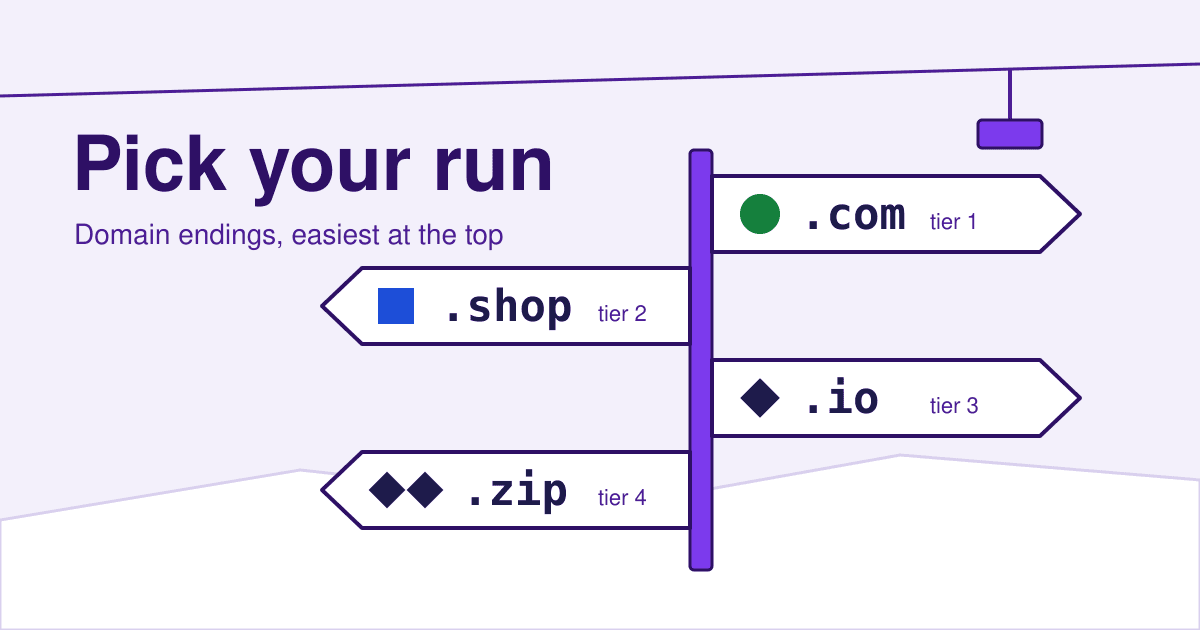
The tier list on one board
- Green circle .com · your country code Start here
- Blue square .org · .net · .eu · .shop, .studio and other words · .app, .dev, .page Good, after one check
- Black diamond .co · .io · .ai, .me, .tv Experienced owners only
- Double black .zip · .mov · endings you do not qualify for Closed for a business site
The tiers rank risk for a small business, not search ranking. Google says new endings are treated "like other gTLDs (like .com and .org)" and that "keywords in a TLD do not give any advantage or disadvantage in search" (Google Search Central, 2015). What changes from tier to tier is price, rules, browser behaviour and how easily people get your address right.
Green circle: start here
-
.com
- Suits
- Any business, and most of all one that customers hear about by word of mouth.
- Why it sits here
- RFC 1591, the 1994 note that described the first endings, set COM aside "for commercial entities, that is companies" (RFC 1591). Google gives it no bonus; its edge is that people add it from memory when they hear a name.
- Watch for
- The short names went long ago. In our view a short extra word in .com, such as your town or trade, beats the bare name in an ending people forget.
- Check before you pay
- Read the address to someone over the phone. If they type it right the first time, it passes.
-
Your own country code: .de, .fr, .co.uk, .ca, .com.au
- Suits
- Shops, trades and practices whose customers all live in one country.
- Why it sits here
- Google calls a country code "a strong signal to both users and search engines that your site is explicitly intended for a certain country", which "can improve your page rankings in the target country, but at the expense of results in other locales or languages" (Google, multi-regional sites).
- Watch for
- Selling abroad later means a second domain or a move. Google also lists "strict ccTLD requirements (sometimes)" among the costs.
- Check before you pay
- Read the registry eligibility page before you buy, and register the .com twin if it is free.
Blue square: good, after one check
-
.org and .net
- Suits
- Clubs, charities and associations (.org); a fallback when the .com is taken (.net).
- Why it sits here
- RFC 1591 meant ORG for "organizations that didn't fit anywhere else" and NET for "the computers of network providers" (RFC 1591). Both are open to any registrant today and Google treats them like .com.
- Watch for
- A shop on .org sends a mixed signal, and a .net with someone else on the .com loses typed visits to them.
- Check before you pay
- Look up who owns the .com of the same name, and what is on it.
-
.eu
- Suits
- Businesses based in the EU that sell across several member states.
- Why it sits here
- Google treats .eu as a "generic regional" ending, "much like .com or .org" (Google, multi-regional sites), so it does not point your site at one country.
- Watch for
- Only an EU citizen, an EU resident, or an undertaking or organisation established in the Union may hold one (Regulation (EU) 2019/517, Article 3). A UK company with no EU base stopped qualifying when the UK left.
- Check before you pay
- Check that the registrant name on the order meets Article 3, and will keep meeting it.
-
Word endings: .shop, .studio, .cafe, .design
- Suits
- A business whose trade fits the word, when the .com of its name is gone.
- Why it sits here
- "Keywords in a TLD do not give any advantage or disadvantage in search" (Google, 2015), so the word helps people, not rankings.
- Watch for
- The renewal price. A registry may raise it with 180 days' notice, and the registrar can renew for up to ten years at the old price before the rise takes effect. A name sold as premium can carry a higher renewal price if that was disclosed when you bought it (ICANN base registry agreement, 2.10(b) and (c)).
- Check before you pay
- Put the name in the cart and read the price for year two, not only year one.
-
.app, .dev, .page
- Suits
- Software, booking tools and web apps.
- Why it sits here
- The whole ending is on the browser HSTS preload list, so browsers only connect over HTTPS. Google Registry calls .app "the world's first HSTS-preloaded top-level domain" (Google Registry, .app).
- Watch for
- A site with no certificate does not load at all, not even with a warning. Chromium's list, read on 12 November 2026, holds 58 entries that cover a whole suffix, among them the endings .app, .dev, .page, .new, .day, .bank and .insurance (Chromium preload list).
- Check before you pay
- Make sure your host issues a certificate for the name before launch day.
Black diamond: experienced owners only
-
.co
- Suits
- Startups that own, or can buy, the matching .com.
- Why it sits here
- It is Colombia's country code, but Google treats it as generic, together with .ai, .io, .me, .tv and 15 others on its list (Google, multi-regional sites).
- Watch for
- It is one letter short of .com. Customers who type from memory add the m, and email sent to your name at the .com goes to whoever owns that domain.
- Check before you pay
- Find out who owns the .com twin before you print a single card.
-
.io
- Suits
- Tech products that accept a country code whose future is open.
- Why it sits here
- It is the code of the British Indian Ocean Territory. The UK signed an agreement on 22 May 2025 to hand the islands to Mauritius (UK government, 22 May 2025). If the IO code leaves the ISO country list, the ccTLD retirement policy allows removal no earlier than five years after notice, and no later than ten (ccNSO retirement policy, sections 4.3 and 4.4).
- Watch for
- On 12 November 2026 the IANA root database still listed .io as delegated and active (IANA, .io). Nobody can say yet whether it will be retired.
- Check before you pay
- Keep a .com or country code you could move to, and set it up to forward today.
-
.ai, .me, .tv and other borrowed country codes
- Suits
- Brands built on the word the code spells.
- Why it sits here
- Google treats them as generic. Each is run by a country registry under its own terms, not under the ICANN gTLD agreement and its 180-day price notice.
- Watch for
- Minimum terms, price changes and local rules set by a registry you have no say in.
- Check before you pay
- Read the registry terms for the minimum term, the renewal price and who may hold a name.
Double black: closed for a business site
-
.zip and .mov
- Suits
- Almost no small business.
- Why it sits here
- Google Registry launched .zip in May 2023 (Google Registry, .zip). Both endings are also file types, and both are on the HTTPS-only preload list.
- Watch for
- A customer who writes "photos.zip" or "clip.mov" in an email or chat may see it turned into a link to whoever owns that name. Read aloud, your address sounds like an attachment.
- Check before you pay
- Say the full address out loud. If it sounds like a file name, pick another ending.
-
Endings you do not qualify for
- Suits
- Nobody outside the trade or territory they were made for.
- Why it sits here
- Restricted endings such as .bank and .insurance are for verified businesses in those trades; country codes and .eu have residence or establishment rules.
- Watch for
- A name held through a reseller or a friend abroad to get round the rules can be lost when the registry checks.
- Check before you pay
- If you need a workaround to register it, it is not your ending.
Six checks at the ticket window, before you pay
-
Say it on the phone
Read the full address to a friend who has never seen it. Count how many tries they need. Anything over one costs you visitors forever.
-
Read the year-two price
The first year is often a promotion. If the registry announces a rise, ICANN's agreement gives you 180 days to renew for up to ten years at the old price (section 2.10(b)).
-
Read the eligibility page
For a country code or .eu, check that the person or company on the order qualifies, and will still qualify if you move.
-
Check for HTTPS-only endings
Search the ending on hstspreload.org. If it is preloaded, nothing works over plain HTTP, so the certificate comes first.
-
Buy the twin
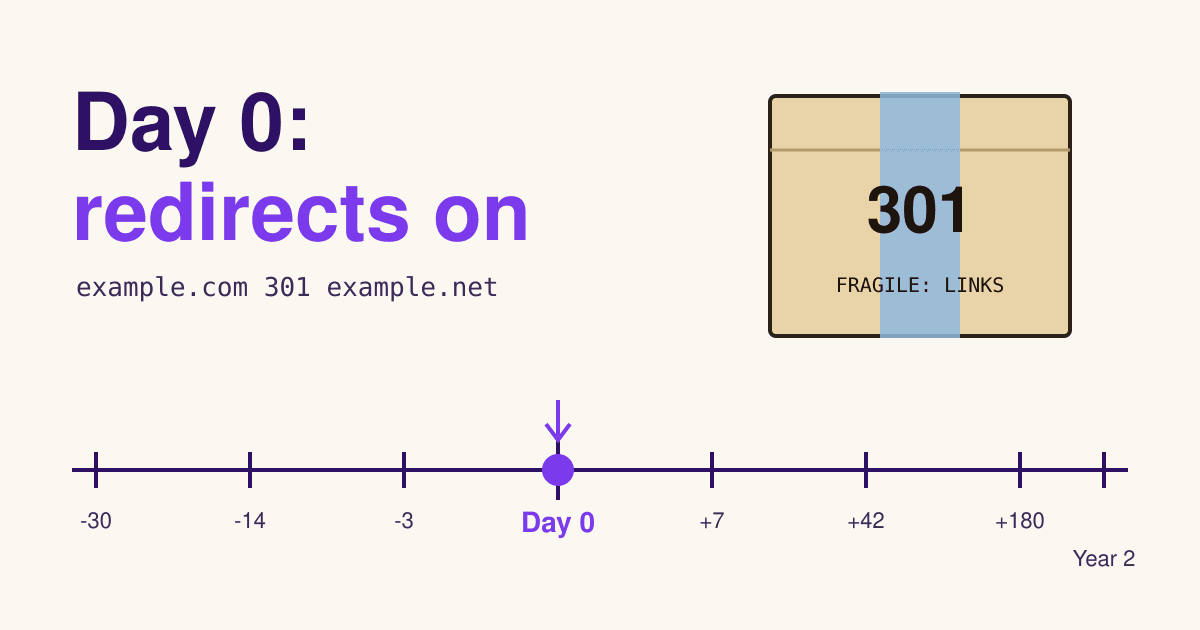
Register the .com or country code people will guess, and send it to your main domain with one permanent redirect, as in the code below.
-
Pick one email domain
Print one email address, on the main domain. A spare domain should only forward visitors, never carry the address on your van.
Point the spare endings at the main one
A made-up bakery owns example.com and holds example.co and example.de as spares. One server block sends every spare address, with its path, to the main domain.
# nginx: every spare name answers with one 301 to the main domain
server {
    listen 443 ssl;
    server_name example.co www.example.co example.de www.example.de;
    # ssl_certificate and ssl_certificate_key for these names go here
    return 301 https://example.com$request_uri;
}

# check it: the Location line should name the main domain and keep the path
curl -sI https://example.co/menu | grep -i '^location'
# location: https://example.com/menu
Keep a plain HTTP server block for the same names with the same return line, unless the spare ending is HTTPS-only. On shared hosting, the domain panel usually has a "forward with 301" switch that does the same job.
Questions owners ask about domain endings
Does a .com rank better than a .shop?
No. Google says it treats new endings like .com and that a keyword in the ending gives no advantage or disadvantage. The difference is in people: they guess .com more often.
Should I buy my name in every ending?
No. Buy the ones people will guess, usually .com and your country code, and forward them. Buying ten endings means ten renewals for visitors who never arrive.
Can I switch to a better ending later?
Yes, as a site move with redirects. Google warns that domain changes "can take time to be processed for Search" and that people expect email addresses to keep working, so it is "generally best to choose a domain that will fit your long-term needs".
Is .io going away?
Not as of 12 November 2026: it is still delegated in the root zone. If its country code is withdrawn, the retirement policy gives five to ten years before removal.
Sources
- Google Search Central: Managing multi-regional and multilingual sites, including its list of generic country codes
- Google Search Central blog: Google's handling of new top level domains (2015)
- RFC 1591: Domain Name System Structure and Delegation (1994)
- ICANN Base Registry Agreement (21 January 2024), section 2.10 Pricing for Registry Services
- Regulation (EU) 2019/517 on the .eu top-level domain, Article 3
- Chromium HSTS preload list, read 12 November 2026 and hstspreload.org
- Google Registry: .app and .zip
- IANA Root Zone Database: .io
- UK government: agreement with Mauritius signed 22 May 2025
- ccNSO: Proposed Policy for the Retirement of ccTLDs, final report (June 2021)
Rules and lists checked on 12 November 2026. Prices and terms change; read your registrar's cart before you pay.