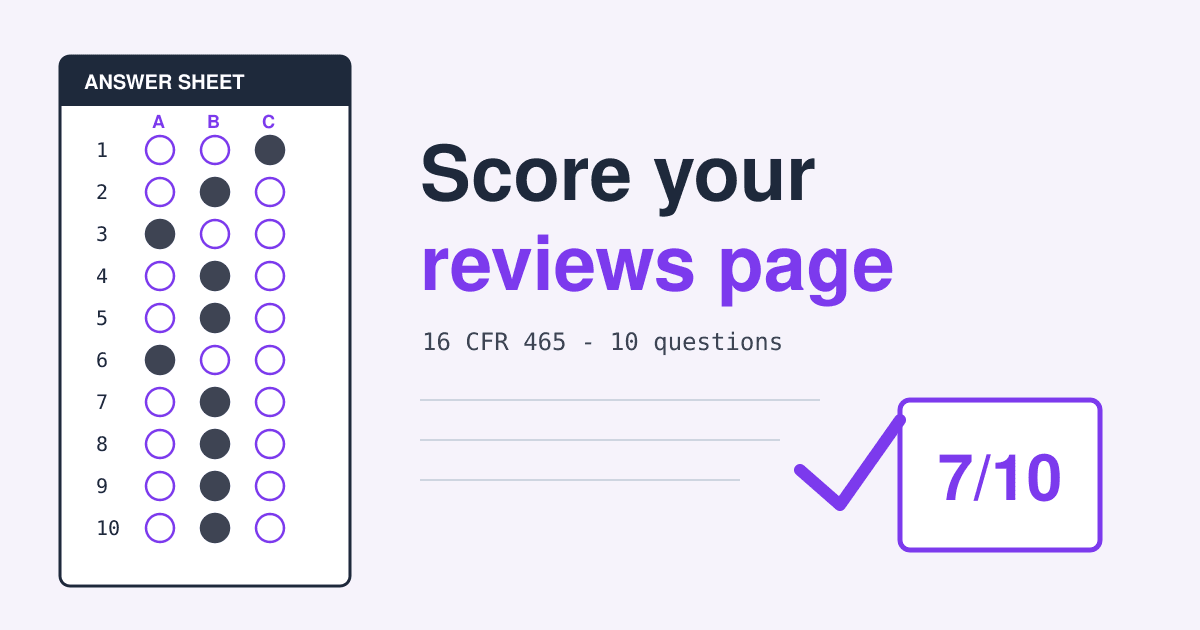
This paper has ten questions, one mark each, and every one of them is a decision a small business really makes about the testimonials, star widgets and review requests on its own pages.
- Answer every question by picking one letter. Write your letters down before you turn to the mark scheme.
- The marks follow the US Federal Trade Commission rule on consumer reviews and testimonials (16 CFR Part 465), the FTC Endorsement Guides (16 CFR Part 255) and Google's own review policies. UK rules get a note at the end.
- This is a reading of the rules for website owners, not legal advice for your case.
Short answer
Short answer: since the FTC rule took effect on October 21, 2024, a business may not invent or buy fake reviews or testimonials, pay only for positive (or negative) reviews, show staff or family reviews without saying who wrote them, or present a filtered set of reviews as all of them. Knowing breaches can cost up to $53,088 per violation. You may still ask every customer for a review, offer the same small thank-you whatever they write (disclosed, and never for Google reviews), and hide abusive or personal content under one rule for all ratings. Keep a file for every quote you show, and if a testimonial promises a result, say what customers generally get.
Section A: the ten questions
-
1 Your designer fills the testimonial slider with three quotes from "Sarah K.", "Mike T." and "Linda P." until real ones come in. Launch day arrives and none have. What do you do?
- A. Keep them. First names and an initial are generic enough to be harmless.
- B. Keep them and add the word "sample" in small grey type under the slider.
- C. Take the slider down until real customers give you quotes you can use.
[1 mark]
-
2 After every order you email: "Review us and get 10% off your next order." Which statement is right?
- A. The FTC rule bans any reward for a review, so this email is unlawful.
- B. The FTC rule allows it if the discount does not depend on a good review and the reward is disclosed, but Google does not allow it for Google reviews.
- C. It is allowed everywhere as long as the discount is worth less than $20.
[1 mark]
-
3 Your review tool asks "How did we do?" Customers who tap 4 or 5 stars get a link to your Google review page. Those who tap 1 to 3 get a private feedback form.
- A. Fine. Unhappy customers are still heard, just in private.
- B. Risky. The FTC says sorting who gets asked by how happy they are may be unfair or deceptive, and Google forbids selectively asking for positive reviews.
- C. Fine, as long as you answer every private complaint within a day.
[1 mark]
-
4 Your on-site review widget has a "minimum rating to display" setting. You set it to 4 stars. The header reads "What our customers say: 212 reviews".
- A. Fine. It is your website and you choose what it shows.
- B. A breach. The page presents the reviews it shows as all the reviews while hiding the rest because of their rating.
- C. Fine, as long as the average star figure is worked out from all 212 reviews.
[1 mark]
-
5 A one-star review on your site names an employee and gives her home street. A five-star review on the same page is full of swearing. You may:
- A. Hide the one-star review and keep the five-star one.
- B. Hide both, under a written rule you apply to every review whatever its rating.
- C. Hide neither. Any moderation at all counts as review suppression.
[1 mark]
-
6 Your shop manager asks two staff members and her brother to post five-star Google reviews to lift the average.
- A. Fine, if they genuinely like the business.
- B. Fine on Google, but it would be a problem on your own site.
- C. A breach unless each review clearly says who wrote it, and the manager has to tell them to say so.
[1 mark]
-
7 Your web studio home page quotes a client: "Our new site tripled our bookings in a month." Most clients see a much smaller lift. What does the page need?
- A. Nothing. It is the client's honest experience in their own words.
- B. A line under the quote saying "Results not typical".
- C. Proof that tripling is typical, or a clear line saying what clients generally get, which you can back up.
[1 mark]
-
8 You add Review and AggregateRating structured data for your own LocalBusiness to the home page, built from your testimonials. What does Google show?
- A. Gold stars under your search result within a few weeks.
- B. No stars. Reviews a business hosts about itself do not qualify, and an embedded review widget changes nothing.
- C. Stars, but only after you collect more than 50 reviews.
[1 mark]
-
9 Your terms of service say a customer agrees not to post negative reviews, or pays a $500 fee if they do.
- A. Enforceable, because the customer ticked the box accepting the terms.
- B. Void, and offering a form contract with that clause is itself unlawful.
- C. Fine, as long as you never actually charge the fee.
[1 mark]
-
10 A client wrote: "Great looking site, but it launched three months late and over budget." Your testimonials page quotes: "Great looking site."
- A. Fine. Those are the client's exact words.
- B. Not fine. A quote may not be cut so that it distorts the opinion, and quotation marks promise the words as said.
- C. Fine, if the quote links to the full review.
[1 mark]
Mark scheme
One mark per correct letter. Each answer names the line of the rule or policy it rests on, then the correction to make on your site if your own page does what the wrong answer does.
-
Question 1: C
Section 465.2(a) makes it a violation for a business to write or create a testimonial that misrepresents that the person exists or used the product. A placeholder quote shown on a live site is exactly that. Answer B fails because the rule wants any disclosure to be "difficult to miss" (465.1(c)), and small grey type under a slider is not; a labelled sample also tells visitors nothing true about you.
Correction Ship the page without the slider, or with one line inviting the first customers to send a quote. Add quotes as they arrive.
-
Question 2: B
The rule bans rewards "conditioned expressly or by implication" on a review with a particular sentiment (465.4). A reward for any honest review is not banned, but it is a material connection that Endorsement Guides 255.5 say must be disclosed. Google is stricter: its Maps content policy does not allow merchants to offer payment, discounts or free goods "in exchange for posting any review".
Correction Keep the thank-you only for reviews on your own site, send it whatever the rating, and print a line on each such review saying a discount was given.
-
Question 3: B
This is called review gating. Endorsement Guides 255.2, Example 11 describes a marketer inviting only the happy customers to post reviews and says it "may be an unfair or deceptive practice" if the posted reviews end up more positive than they would otherwise be; inviting every customer would have been fine, "even if it had expressed its hope for positive reviews". Google's policy names "selectively solicit positive reviews" as not allowed.
Correction Send every customer the same review link. Keep the private feedback form as a separate, optional question.
-
Question 4: B
Section 465.7(b) bans presenting the reviews on a page as most or all of them while reviews are being held back because of their rating or negative sentiment. Endorsement Guides 255.2, Example 8 uses this very case: a retailer that does not publish reviews under four stars makes its pages "misleading as to purchasers' actual opinions". A correct average under a filtered list (answer C) still shows visitors a picked set.
Correction Set the widget minimum to 1 star, or label the block plainly as a selection and link to all reviews.
-
Question 5: B
The same section lists criteria that are not suppression when "applied equally to all reviews submitted without regard to sentiment": personal information or likeness of another person, and defamatory, harassing, abusive, obscene or vulgar content, among others (465.7(b)(1)). Example 8 in the Guides adds that blocking negative reviews with profanity while posting positive ones with profanity would be misleading.
Correction Write your moderation rule in two or three lines, publish it under the reviews, and apply it to five-star and one-star reviews alike.
-
Question 6: C
Section 465.5(c) makes it a violation for an officer or manager to ask employees or immediate relatives (a sibling counts, 465.1(i)) for reviews when those reviews then appear without disclosing the relationship and the manager did not tell them to disclose it. Google's policy also treats current or former employment and family ties as a conflict of interest, so the reviews are likely to be removed there anyway.
Correction Do not ask staff or family for reviews on review sites. If they write one on their own, they say who they are in the first line.
-
Question 7: C
A testimonial about a key result is read as what customers generally achieve (255.2(b)). Without proof of that, the page should say clearly what results are generally expected and be able to back that figure up. Example 2 of the same section records that the FTC tested "Results not typical" and found it did not change what readers took away, so answer B does not fix the page.
Correction Measure what your clients usually get, put that figure next to the quote, or swap the quote for one about something every client gets, such as being kept informed.
-
Question 8: B
Google's review snippet guidelines say that when the entity being reviewed controls the reviews about itself, its pages with LocalBusiness or any other Organization markup are ineligible for star results, whether the reviews sit in the markup or come through an embedded third-party widget. The markup does no legal harm on its own, but it earns nothing.
Correction Remove self-serving review markup from your own business pages, and send people to your Google Business Profile reviews instead.
-
Question 9: B
Under the Consumer Review Fairness Act (15 USC 45b) a form contract clause that restricts honest reviews, or charges a fee for them, is void from the start, and offering a form contract that contains one is unlawful in its own right, enforced by the FTC as a rule violation. The Act still lets you remove content from your own site that is, for example, abusive or holds someone else's personal information.
Correction Delete any non-disparagement or review fee clause from your terms, checkout text and contracts.
-
Question 10: B
The Guides allow an endorsement to be quoted in part, but it "may not be presented out of context or reworded so as to distort in any way the endorser's opinion or experience", and quotation marks tell the reader they are seeing the exact words (255.1(b)). Cutting the "but" turns a mixed review into a rave.
Correction Quote the whole sentence, or ask the client for a new quote. A short honest quote with a qualifier still reads as real.
Grade boundaries
| Marks | Grade | What to do next |
|---|---|---|
| 10 | Distinction | Write down what you already do as a short review policy, so the next person who edits the site keeps doing it. |
| 8 to 9 | Pass | Open the pages behind the questions you missed and make those corrections this week. |
| 5 to 7 | Resit | Check every testimonial, widget setting and review email against the mark scheme before your next campaign. |
| 0 to 4 | Fail | Turn off widget filters and take down quotes you cannot trace today, then work through the corrections in question order. |
Your mark measures what you know. The page that counts is the live one, so after the paper open your home page, your testimonials page and your review request email side by side and score them too.
The testimonial file: one card per quote
Most of the questions come down to one habit: being able to show where a quote came from. Keep a card like this for every testimonial and review you show outside a review widget, in a folder or a spreadsheet. The values are an example.
- Quote as shown
- "The booking page paid for itself in the first season."
- Full original text
- Email from the client, 2026-04-12, pasted in full
- Who and how to reach them
- Guesthouse owner, client since 2025, reply address kept
- Permission to publish
- "Yes, use it with my first name and town", 2026-04-14
- Anything given in return
- None (if a discount or gift: what, and the disclosure line used)
- Relationship to the business
- Paying client only (if staff, family or partner: the disclosure line used)
- Result claimed, and what is typical
- "Paid for itself": the figure you measured across clients, with its date
- Next check
- Ask again in a year whether they still stand by it
The last line comes from the Guides too: an advertiser may keep using an endorsement only while it has good reason to believe the endorser still holds that view (255.1(b)).
Disclosure lines to copy
Two pieces of HTML for the cases in questions 2, 6 and 7: a testimonial with its typical result beside it, and a review that came with a reward. Keep the note in normal-size text next to the quote, not in a tooltip or behind a link: the rule says a disclosure a visitor must click or hover to see is not clear and conspicuous (465.1(c)(4)).
<figure class="testimonial">
  <blockquote>
    <p>The booking page paid for itself in the first season.</p>
  </blockquote>
  <figcaption>Guesthouse owner, client since 2025</figcaption>
  <p class="typical">Across our clients, [your measured figure and its date].</p>
</figure>

<article class="review">
  <p>Fast delivery and the size was right.</p>
  <p class="review-note">This customer got a 10% code for leaving a review.
  Every reviewer gets it, whatever the rating.</p>
</article>
Questions candidates ask
Does the rule apply to a one-person business?
Yes. The rule defines a business as any individual, partnership, corporation or other commercial entity that sells products or services (465.1(a)). There is no size threshold.
Can I use an AI tool to write reviews or testimonials?
Not in a customer's name. The rule bans a business writing or creating a review or testimonial that misrepresents that the reviewer exists or used the product (465.2(a)), and text a tool wrote for a person who never said it falls under that. Using a tool to tidy the spelling of a real customer's words is a different matter, as long as the meaning stays theirs.
What about bought followers or likes shown on my site?
Buying fake followers, likes or views that you know are fake, to make a business look more popular for a commercial purpose, is a violation of its own (465.8). A social proof badge counting them repeats the problem on your pages.
I sell to customers in the UK. Is it different there?
Similar, and in one way stricter. Since 6 April 2025 the UK Digital Markets, Competition and Consumers Act 2024, Schedule 20, paragraph 13 bans fake reviews and reviews that hide an incentive, bans publishing reviews in a misleading way, including giving positive reviews more prominence than negative ones, and requires reasonable and proportionate steps to stop fake reviews from appearing at all.
Can I reply to a bad review?
Yes, and a calm public reply often helps more than the review hurts. What the rule bans is trying to get a review removed or prevented through unfounded legal threats, physical threats, intimidation, or public accusations you know or should know are false (465.7(a)).
Sources
- US Federal Trade Commission: 16 CFR Part 465, Rule on the Use of Consumer Reviews and Testimonials and the final rule in the Federal Register, 89 FR 68034, published 2024-08-22, effective 2024-10-21.
- US Federal Trade Commission: 16 CFR Part 255, Guides Concerning the Use of Endorsements and Testimonials in Advertising, as revised 2023-07-26.
- US Federal Trade Commission: 16 CFR 1.98, adjustment of civil penalty amounts, $53,088 under FTC Act section 5(m)(1)(A) for penalties assessed after 2025-01-17.
- Consumer Review Fairness Act of 2016, 15 USC 45b, Legal Information Institute.
- Google Search Central: Review snippet structured data; Google Maps: Fake engagement and conflict of interest policy. Read 2026-11-12.
- UK: Digital Markets, Competition and Consumers Act 2024, Schedule 20, paragraph 13, in force 2025-04-06.