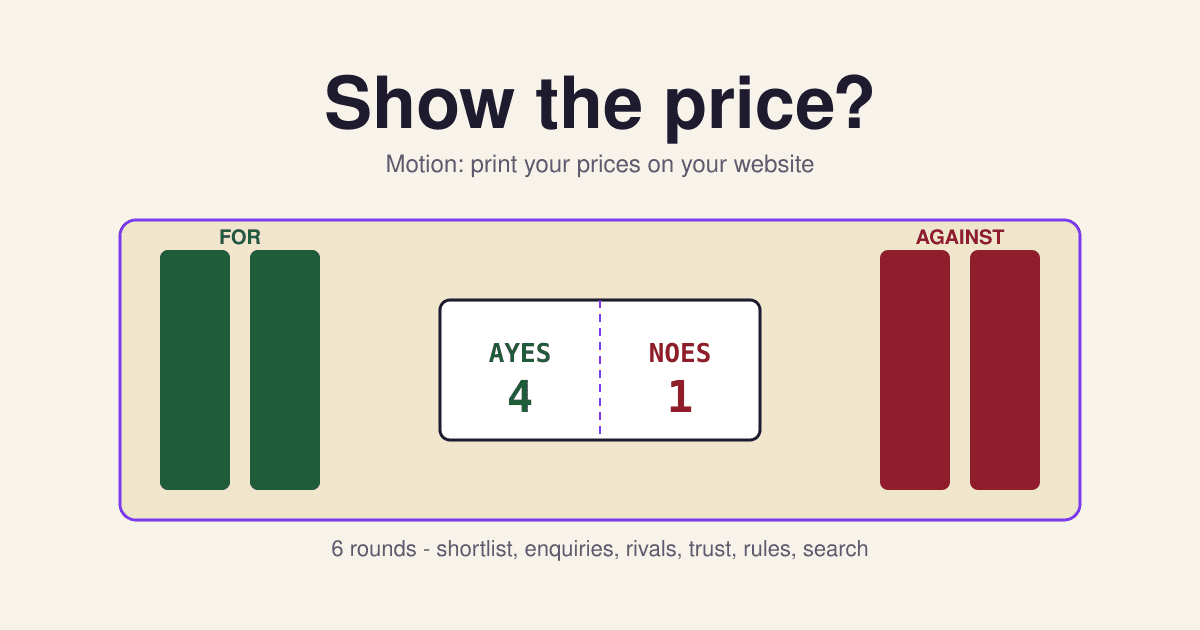
This house believes that a small business should print its prices on its own website, and the case against comes from every builder, designer and consultant who says no two jobs cost the same.
Below, both benches speak in six rounds: getting onto a buyer's shortlist, the enquiries you get, what rivals learn, how the page reads, the rules that apply, and search. Each round ends with a ruling, and the division at the end shows which way each kind of business should vote.
Short answer
Short answer: show prices if you sell products or set-price services, and show a range with two or three sample jobs if every job is quoted. Keep "price on request" for one-off commissions and sealed bids. Visitors look for the price first and move on to rivals that show one, and in the EU a service with a set price already has to make that price available, so hiding it buys little. The motion carries by four rounds to one, with one round tied.
The debate in six rounds
Round 1 Getting onto the shortlist
Price is what people look for first. In Nielsen Norman Group's usability studies, participants left sites that hid prices and went to competitors that showed them, and the first few sites with good product information, prices included, tend to make the shortlist. A buyer who cannot tell whether you cost 500 or 5,000 drops you before you get a chance to talk.
No two jobs cost the same. One number on a page will be wrong for most visitors, and a low "from" figure sets an expectation that the real quote then has to break, which is worse than no number at all.
The opposition names a real problem, but the same research answers it: when an exact price is impossible, show prices for a few typical cases. In one test a simple table of sample prices beat a calculator that asked for full details, because a buyer at the shortlist stage only needs the level, not the quote.
Round 2 The enquiries you get
Every call from someone who leaves when they hear the number costs you the time of that call, and often a site visit. A price on the page sorts those people out before they ring, so the calls you do get are from people who have already accepted the level.
A hidden price makes people get in touch, and a conversation is where you sell. Some visitors who would balk at a bare number will book once they hear what the job includes and who will do it.
Both sides are describing the same trade: more enquiries against better ones. Neither has your numbers. Count jobs won, not enquiries: run eight weeks each way and log enquiries, quotes sent and jobs won. The version that wins more jobs per hour you spend answering wins the round for your business.
Round 3 What rivals learn
A rival who wants your price can phone you as a customer and ask for a quote. Hiding the price costs them five minutes and costs every real buyer a phone call. Nielsen Norman Group lists "we don't want our competitors to know" among the usual reasons sites give for hiding prices, and calls it an excuse.
A public price list is an open invitation to undercut by a small margin. A competitor can price every line just under yours and mention it in their own pitch.
Ayes, except where work is won by sealed bid. For tendered contracts the price is the bid, and publishing it does help the other bidders. For everyone else, buyers compare prices anyway; the only question is whether yours is one of the prices they see.
Round 4 How the page reads
A hidden price reads as evasive. Nielsen Norman Group describes a halo effect: "they're hiding the information I want" spreads to "they're difficult to deal with". It also notes that a missing price makes some buyers think "if I have to ask, I can't afford it" and leave, including people who could.
For one-off and luxury work, a price list makes the work look like a stock item. "Price on request" tells the visitor each piece is made for them. Even EU price rules allow member states to leave works of art and antiques out of the duty to show a price.
Noes, but only for work that really is one of a kind: commissions, art, bespoke furniture, private events built from scratch. Even there, say the band your work usually falls in once a visitor asks, so "on request" never sounds like "out of your league".
Round 5 The rules that apply
Hiding the price does not take you outside the rules. The EU Services Directive says that where a provider has a set price for a type of service, that price must be made available (Article 22(1)(i)), and a web address where it can be read is one of the allowed ways (22(2)(c)). For services without a set price, the customer can ask for the price, the method of working it out, or a detailed estimate (22(3)(a)).
Showing a price brings duties with it. In the EU a selling price shown to consumers must be the final price including VAT and all other taxes. In the US, since May 12, 2025, a business selling live-event tickets or short-term lodging that shows any price must show the total price more prominently than other pricing (16 CFR 464.2). A careless price page becomes a liability.
Ayes. The duties the opposition lists apply to how a price is shown, not to whether you show one, and a business with set prices in the EU already owes them to its customers. Show consumer prices with VAT included, and if you sell US lodging or tickets, lead with the total. This is a reading of the rules for website owners, not legal advice for your case.
Round 6 Search
People type "how much does it cost" before they type your name. A page that answers with a number can answer that search. A pool builder's blog gives an installed concrete pool at $50,000 to $100,000 or more: a range, not a quote, and still an answer. For shops, Google's merchant listing structured data carries the price in the offer.
Price pages go stale. That same pool page is titled as a 2021 guide and dated January 22, 2020. A price that was right three years ago misleads today, and every price you publish is one more thing to keep current.
Ayes, with a condition: put a "prices checked" date on every price page, change it each time you check, and set a reminder to check every quarter. A stale price is a maintenance problem, not a reason to show none.
The division: how each kind of business should vote
The rounds do not land the same way for everyone. Find the row that matches how you sell; "must" marks the cases where the rules above already decide it.
-
Shop selling products to consumers
Show: required
In the EU the final price with VAT and taxes on every product (Directive 98/6/EC, Article 3).
-
Set-menu services: salons, cleaners, tutors, accounting packages
Show the list
An exact price per service. In the EU a set price must be available anyway (Article 22(1)(i)).
-
Quoted project work: builders, kitchen fitters, web designers, photographers
Show a range
A "most jobs land between" range, two or three sample jobs with what they included, and the factors that move the price.
-
Business-to-business contracts and software plans
Show tiers or samples
A starting tier or prices for typical scenarios; buyers still expect to negotiate from a list price.
-
US short-term rentals, hotels and event tickets
Show the total
Any price shown must lead with the total price, mandatory fees included (16 CFR 464.2).
-
One-off commissions, art, bespoke luxury work
Price on request
No public list, but a quick answer with your usual band to anyone who asks.
-
Tendered or sealed-bid contracts
Price on request
The price is the bid. Show past project sizes and what you deliver instead.
The amendment: if you keep "price on request", make it answer anyway
A business that votes no can still give the visitor most of what a price would. Five lines turn a bare "contact us for a quote" into a page that keeps buyers on it:
- Say why the price varies. Name the three or four things that move it (size, materials, access, deadline), so the visitor can guess where they sit.
- Give a band. "Most kitchens we fit cost between X and Y" answers the shortlist question without promising a figure.
- Show worked samples. Two or three past jobs with what was included and what they cost, the way Nielsen Norman Group recommends for complex pricing.
- Say when the quote comes. "Free, in writing, within two working days" tells the visitor what asking costs them.
- Ask only what the quote needs. Every extra form field is a reason to try the next site instead.
Kitchen fitting
Most fitted kitchens: 6,000 to 14,000 EUR, VAT included
- Galley kitchen, 3 m run, units supplied by customer6,400 EUR
- L-shaped kitchen, new worktops, electrics moved9,800 EUR
- Open-plan kitchen with island, plumbing rerouted13,900 EUR
What moves the price: room size, worktop material, moving water or power, removal of the old kitchen. Written quote free within two working days. Prices checked: 2026-11-24.
Questions from the floor
Should the prices on my site include VAT?
If you sell to consumers in the EU, yes: the selling price under the Price Indication Directive is the final price including VAT and all other taxes. If you sell only to businesses, prices excluding VAT are common, but label them "excl. VAT" right next to the figure so nobody reads them as totals.
Is a "from" price enough?
Only if a real customer can buy at that price. A "from" figure that almost nobody gets is the expectation trap the opposition warned about in round 1. A band with sample jobs does the same work more honestly.
Will showing prices cut my enquiries?
It may cut the number and raise the share that turn into jobs. Measure both for a few weeks before and after; the result that matters is jobs won per hour spent answering enquiries.
What about a price calculator instead?
In Nielsen Norman Group's testing, calculators that need precise input were slow and error prone for buyers who only wanted a rough idea. Show sample prices first and offer a calculator as an extra for those who want detail.
Sources
- Nielsen Norman Group: State the Price to Give B2B Sites a Competitive Advantage and Show Prices for Common Scenarios. Read 2026-11-12.
- Directive 98/6/EC on consumer protection in the indication of the prices of products: Article 2 and Article 3, text as adopted, legislation.gov.uk.
- Directive 2006/123/EC on services in the internal market: Article 22, information on providers and their services, text as adopted, legislation.gov.uk.
- US Federal Trade Commission: 16 CFR Part 464, Rule on Unfair or Deceptive Fees; final rule, 90 FR 2166, published 2025-01-10, effective 2025-05-12.
- River Pools: Inground Concrete Swimming Pool Cost and Price Guide 2021, dated 2020-01-22. Read 2026-11-12.
- Google Search Central: Merchant listing (Product, Offer) structured data. Read 2026-11-12.