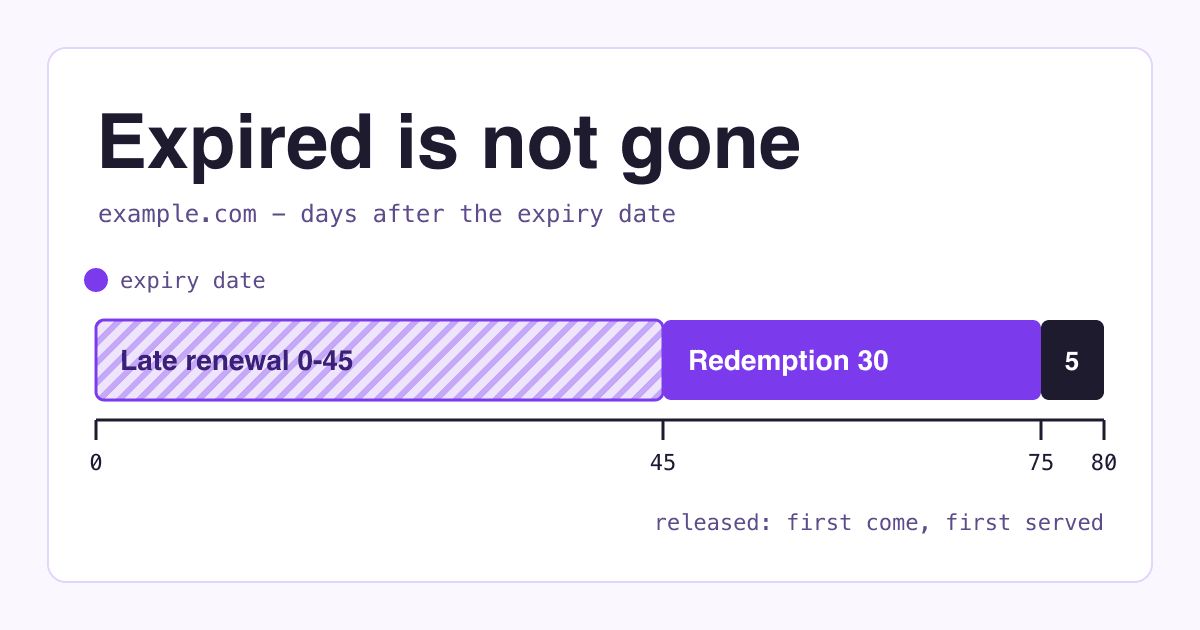
A domain name you forget to renew does not disappear on its expiry date: for .com and the other generic domains, ICANN rules move it through a late-renewal window that usually lasts up to 45 days, a 30-day redemption period and 5 days of pending delete before anyone else can register it.
What happens when a domain name expires?
Short answer
Your registrar sends reminders about one month and one week before the date, and one more within five days after it unless you renewed it or the registrar deleted it by then (ICANN Expired Registration Recovery Policy, 2.1). After the date, your website and email can stop at any time: where the registry allows it, the policy requires the registrar to switch them off for at least the last eight days before it deletes the name, or from the expiry date on if it deletes the name sooner. Once deleted, it sits in a 30-day redemption period where only you can restore it, for a fee, then 5 days of pending delete, then it is released to the first person who registers it (ICANN registrant FAQ). One exception matters: before deletion, some registrars' terms let them transfer an expired name to someone else, for example through an auction; ICANN's FAQ warns that an unrenewed name "may be transferred or released". Renew as early as you can: every phase costs more and leaves fewer options.
This letter covers generic top-level domains such as .com, .net, .org and the newer ones like .shop. Country-code domains (.uk, .de, .fr and others) are not bound by this ICANN policy; their registries set their own timelines, so read your registrar's terms for those. A few sponsored generic extensions, such as .museum and .travel, also need not offer a redemption period (ERRP 3.1).
How long do you have after the expiry date?
Usually no more than about 80 days, and possibly much less; the policy sets no hard maximum. The first window, after expiry and before deletion, is the one your registrar controls: ICANN's own life-cycle chart puts the registry's auto-renew grace period at 0 to 45 days, and the policy lets a registrar delete an expired name "at any time after they expire" (ERRP 2.2.1). The two windows after deletion are fixed: 30 days of redemption and 5 days of pending delete (ICANN, EPP status codes).
- Reminder notices About day -30 and day -7, and once by day 5
- Registered, renews at the normal price Until day 0
- Expired, still renewable Day 0 to usually day 45 at the latest, set by your registrar
- Redemption grace period 30 days after deletion
- Pending delete 5 days
Which phase is your domain in, and what does each one cost?
| Phase | How long | Website and email | Who can get it back | What you pay |
|---|---|---|---|---|
| Registered | The term you paid for, typically 1 to 10 years | Working | You renew at any time | Your normal renewal price |
| Expired, renewable | From day 0 until the registrar deletes it, typically up to 45 days | May keep working at first; off for at least the last 8 days before deletion (all of it, if deleted within 8 days) | You: renew it with your registrar; a transfer only if the name is unlocked and time is left | The registrar's post-expiration renewal fee, which may differ from the normal one |
| Redemption grace period | 30 days after deletion | Off: the registry disables DNS | You, only through the registrar that deleted it; no transfers | Renewal plus a restore (redemption) fee |
| Pending delete | 5 days | Off | Nobody | Nothing can be paid |
| Released | From then on | Whatever the next owner puts there | Anyone, first come, first served | A new registration, if you are first |
Sources: term length and transfers, ICANN registrant FAQ; DNS and fees, ERRP 2.2, 3.2 and 4.1; phase lengths, ICANN EPP status codes. A registrar with a website must show its renewal, post-expiration renewal and restore fees there (ERRP 4.1.1).
What stops working while the domain is expired?
Everything that needs your domain name to resolve. The registrar may point the name at its own page, which by policy must say the domain has expired and explain how to renew it (ERRP 2.2.4); during redemption the domain resolves to nothing at all (ERRP 3.2).
-
Returned
Your website
Visitors get the registrar's expiry notice or an error page. Links from other sites, directories and old posts all lead there too.
-
Returned
Your email
Mail to any address at the domain stops arriving, because mail servers find your inbox through the same DNS. ICANN's life-cycle chart notes that in redemption the "website and email no longer function".
-
Returned
Certificate renewals
The common way to renew a free SSL certificate asks your web server, at your domain, for a check file (Let's Encrypt, challenge types). If the name does not resolve, that check fails.
-
Returned
Password resets and sign-ins
Any account whose login email sits on the expired domain cannot receive a reset link, and that can include the registrar account you need to renew it.
After release, the risk changes: someone else can register the name and put anything on it. Google names this as one of its spam policies:
"Expired domain abuse is where an expired domain name is purchased and repurposed primarily to manipulate search rankings by hosting content that provides little to no value to users."
Your old links, listings and reviews would then point at their pages.
How do you get an expired domain back?
Look the name up in ICANN Lookup: it shows the registrar, the dates and the status codes. Keep your registrar account open next to it, then answer one question at a time.
-
Does the lookup find the domain at all?
Yes: go to the next question.
No: it has been released. Register it now, before someone else does.
-
Is the domain still in your registrar account?
Yes: go to the next question.
No: it may have been transferred to a new holder or registered by someone else. Contact the registrar shown in the lookup today and ask what happened to it.
-
Do the status codes include
redemptionPeriodorpendingRestore?Yes,
redemptionPeriod: the registrar has deleted it. Ask that registrar for a restore today; it can no longer be transferred, and you have what is left of the 30 days.Yes,
pendingRestore: a restore has already been requested, and the registry is waiting for the registrar's restore report, often within seven days. Confirm with your registrar today that it has sent that report: if it never arrives, the name falls back toredemptionPeriod.No: go to the next question.
-
Does it show
pendingDeleteon its own?Yes: the redemption period has ended and the name will be purged within a few days. It cannot be restored; your only route is to register it once it is released, if no one is faster.
No: go to the next question.
-
Does your registrar account show the domain as expired?
Yes: it is expired but not deleted (the status may show
autoRenewPeriodorclientHold). Renew it now with your current registrar: a renewal is usually processed right away. A transfer to another registrar is not a safe shortcut. It fails while the name hasclientTransferProhibited, a lock you remove in your registrar account, or ask the registrar to remove (ICANN EPP status codes); the registrar may refuse it in the first 60 days after a registration or a previous transfer; and it can take up to five days to complete (ICANN Transfer Policy, I.A.3.5 and I.A.3.7). If you cannot renew, contact the registrar.No: nothing is lost. Renew for several years if you can, and turn on auto-renew. Use the date in your registrar account: for some extensions the registry renews an expired name automatically, so the public expiry date can already show next year (ICANN, EPP status codes: autoRenewPeriod).
Status meanings: ICANN, EPP status codes. Transfer rules: ICANN registrant FAQ; ICANN Transfer Policy. The redemption and pending-delete states are defined in RFC 3915.
Which beliefs about domain expiry are wrong?
The day a domain expires, anyone can buy it.
Once a generic domain is deleted, nobody else can register it until the 30-day redemption period and the 5 days of pending delete are over (ICANN registrant FAQ). The real early risk is different: some registrars' terms let them sell an expired name before they delete it.
The site still loads, so the domain must have renewed.
A registrar may keep the name resolving for a while after expiry; when it waits 8 days or more to delete it, the policy only requires the cut for the last 8 of them (ERRP 2.2.3). Check the expiry date, not the home page.
Auto-renew is on, so there is nothing to watch.
Auto-renew charges the card on file. ICANN's advice for it is to "keep payment information up-to-date" (ICANN registrant FAQ); an expired card means a failed renewal.
The restore fee is a fixed, official price.
"It is up to your registrar to set their own prices" (ICANN registrant FAQ), and a registrar with a website must show its post-expiration renewal and restore fees there (ERRP 4.1.1).
How do you stop it from happening again?
- Look up the date today. ICANN Lookup shows the expiry date and registrar of any generic domain.
- Turn on auto-renew and keep a valid card on file. Set a reminder for the card's own expiry date too.
- Renew for more than one year. Registrations typically run for 1 to 10 years (ICANN registrant FAQ); a longer term means fewer renewals to miss.
- Send registrar mail to an address on a different domain. If the reminders go to an inbox on the domain that is expiring, the notice after expiry lands in a mailbox that may already be offline.
- Keep the contact details current. The reminders go to the registered holder, so an old address means no reminders.
- Put the date in two calendars, 60 days early. Yours and a colleague's, so a holiday or a job change does not cost you the name.
- Read your registrar's fee page once. Know the post-expiration renewal and restore prices before you need them.
What do the terms mean?
- Registrar
- The company you register and renew the domain with. It sends the reminders and can delete the name after it expires.
- Registry
- The operator of the whole extension, such as .com. It runs the redemption and pending-delete periods.
- Auto-renew grace period
- The window after expiry, 0 to 45 days, in which the registry has renewed the name automatically and the registrar can still delete it and get the fee credited back (RFC 3915; length from ICANN's life-cycle chart).
- Redemption grace period
- The 30 days after deletion in which only the last holder can restore the name, through the registrar that deleted it (ERRP 3.1).
- Pending delete
- The 5 days after redemption in which nobody can restore or register the name.
- ICANN Lookup
- ICANN's free search for a domain's registrar, dates and status codes.
Questions website owners ask
Can I move an expired domain to a cheaper registrar?
Sometimes, but renew first if deletion is close. Before deletion, a registrar may not refuse a transfer just because the name expired, unless a previous registration period is unpaid (ICANN registrant FAQ). The transfer still fails while the name has clientTransferProhibited, until you remove that lock in your registrar account or the registrar removes it (ICANN EPP status codes), and it can be refused in the first 60 days after a registration or a previous transfer, or during a dispute (ICANN Transfer Policy, I.A.3.7-3.8). It can also take up to five days (I.A.3.5), while a renewal is usually processed right away. So: renew now, and wait before you move. For .com, a transfer inside the auto-renew grace period (up to 45 days after the expiry date) cancels the year the registry added at expiry and credits it back to your old registrar (.com Registry Agreement, Appendix 7, 3.1.3). If you paid that registrar for the renewal, you can lose that year unless it refunds you. Wait until 45 days after the expiry date, or ask your registrar first whether the renewal year survives a transfer; other extensions may handle it differently. Once it is in the redemption period, the registrar that deleted it must restore it first.
I never got a reminder. Is that allowed?
No. For generic domains the registrar must send two notices before expiry, and one within five days after it unless the name was renewed or deleted in that time. If you did not receive them, you can file a complaint with ICANN Contractual Compliance (ICANN complaint form).
How soon can someone else register my expired domain?
Through a new registration, not before the registrar deletes it and the 30-day redemption and 5-day pending-delete periods pass: at least 35 days after deletion, usually up to about 80 days after the expiry date. Some registrars' terms also let them sell an expired name to a new holder before deleting it, so renew before the date.
Do .uk, .de or .eu domains follow the same timeline?
Not necessarily. The ICANN policy covers generic domains only; each country-code registry sets its own rules, so check your registrar's terms for the extension you use.
Will the website come back as soon as I renew?
The registrar must restore your DNS settings "immediately or as soon as is commercially reasonable" after you renew (ERRP 2.2.6). Visitors' devices may keep the old answer for a while, depending on how long DNS records are cached.
Sources
- Expired Registration Recovery Policy, ICANN.
- FAQs for Registrants: Domain Name Renewals and Expiration, ICANN.
- Life Cycle of a Typical gTLD Domain Name, ICANN (chart).
- EPP Status Codes: What Do They Mean, and Why Should I Know?, ICANN.
- Transfer Policy, ICANN.
- .com Registry Agreement, Appendix 7: Functional and Performance Specifications, ICANN, 2012.
- RFC 3915: Domain Registry Grace Period Mapping for EPP, IETF, 2004.
- ICANN Lookup, ICANN.
- Submit a complaint, ICANN Contractual Compliance.
- Challenge Types, Let's Encrypt.
- Spam policies for Google web search, Google Search Central.
- All pages read on 2026-10-21.
Yours, the editorsP.S. Look up your expiry date before you close this tab.