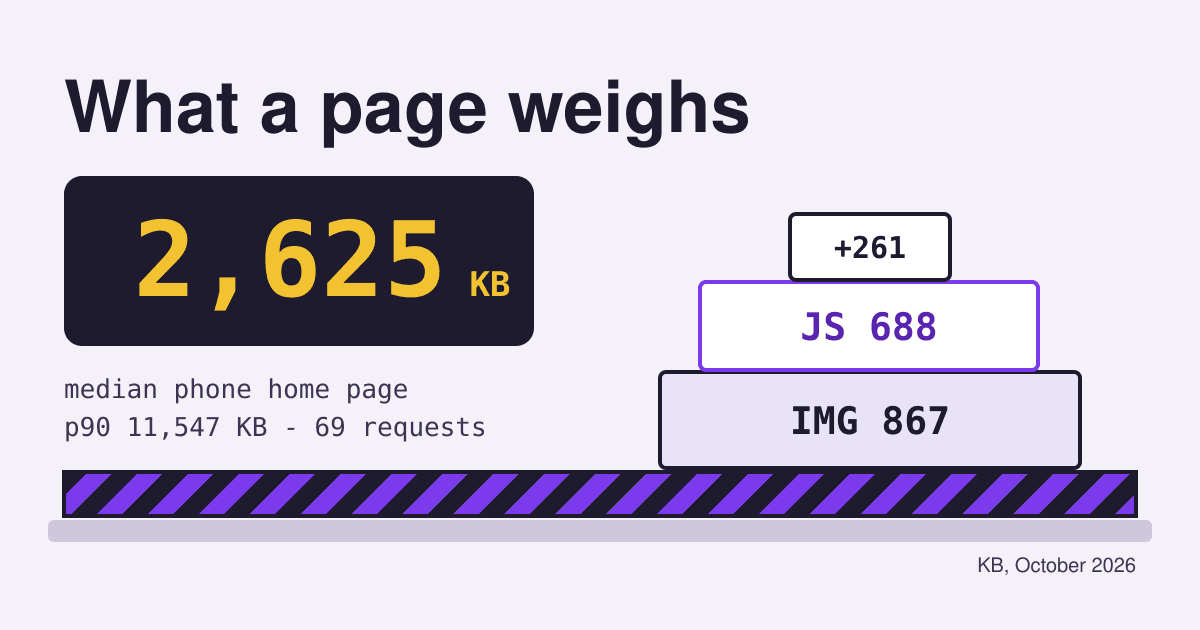
The median home page on a phone now weighs 2,625 KB and pulls in 69 separate files, roughly twice the weight of October 2016 and almost exactly what it weighed a year ago.
- Net, median
- 2,625 KB
- Gross, p90
- 11,547 KB
- Tare, p10
- 522 KB
- Requests
- 69
Short answer: in the October 2026 HTTP Archive crawl of about 15.4 million home pages loaded as a phone, the middle page transferred 2,625 KB (2,987 KB on desktop). Images were the heaviest part at 867 KB, then JavaScript at 688 KB, fonts at 152 KB and CSS at 76 KB. One page in ten weighed more than 11.5 MB. Total weight rose only 0.7% in the year, JavaScript is still the part that keeps growing, and 53% of sites with Chrome field data passed all three Core Web Vitals on phones.
Sixteen weigh tickets from the October 2026 crawl
Every figure is a median (p50) unless the ticket says otherwise: half the pages weigh less, half weigh more. Weights are the transfer size, the bytes that actually crossed the network after compression, as HTTP Archive defines it. Medians of the parts do not add up to the median total, because the middle page for images is not the same page as the middle page for JavaScript.
-
Ticket 01
2,625 KB
Median home page on a phone
The whole page as an emulated Android phone loads it with an empty cache: HTML, images, scripts, styles, fonts and everything else requested during the load.
HTTP Archive page weight, crawl of 1 October 2026
-
Ticket 02
2,987 KB
Median home page on desktop
The same sites loaded in desktop Chrome weigh 14% more. Many sites send the same files to both, and desktop layouts ask for larger images.
HTTP Archive page weight, crawl of 1 October 2026
-
Ticket 03
69 requests
Files per page on a phone
Desktop pages make 74. One page in ten makes more than 213 requests on a phone.
HTTP Archive page weight, crawl of 1 October 2026
-
Ticket 04
867 KB
Images on the median phone page
Still the heaviest part of a typical page, and 5% lighter than in October 2025 (912 KB). Desktop pages carry 1,031 KB of images.
HTTP Archive page weight, crawl of 1 October 2026
-
Ticket 05
688 KB
JavaScript on the median phone page
Up from 452 KB in October 2021, a rise of 52% in five years, and from 576 KB in October 2024. Desktop pages carry 763 KB.
HTTP Archive page weight, crawl of 1 October 2026
-
Ticket 06
152 KB
Web fonts on the median phone page
Twice the 73 KB of October 2016. A font file only counts when the page asks for it, so a page on system fonts scores close to zero here.
HTTP Archive page weight, crawl of 1 October 2026
-
Ticket 07
76 KB
CSS on the median phone page
External stylesheets only. Styles written inside the HTML count toward the HTML ticket below.
HTTP Archive page weight, crawl of 1 October 2026
-
Ticket 08
33 KB
HTML on the median phone page
The document itself, compressed. It is the smallest part by weight and the one every other file waits for.
HTTP Archive page weight, crawl of 1 October 2026
-
Ticket 09
11,547 KB (p90)
The heaviest tenth of phone pages
One home page in ten weighs more than 11.5 MB, over four times the median. The lightest tenth comes in under 522 KB.
HTTP Archive page weight, crawl of 1 October 2026
-
Ticket 10
+0.7% in a year
Median phone page, October 2025 to October 2026
2,607 KB to 2,625 KB. Lighter images almost cancelled heavier scripts, so the total has nearly stopped growing for the first time in years.
HTTP Archive page weight, crawl of 1 October 2026
-
Ticket 11
2.0x since 2016
Median phone page, October 2016 to October 2026
1,323 KB to 2,625 KB in ten years. Five years before that, in June 2011, the median desktop page weighed 524 KB.
HTTP Archive page weight, crawl of 1 October 2026
-
Ticket 12
53% of sites
Pass all three Core Web Vitals on phones
Up from 49.7% in October 2025. On desktop, 61% pass. Each origin is judged on real Chrome visits, not on the crawl.
HTTP Archive CrUX report, October 2026
-
Ticket 13
66% of sites
Good Largest Contentful Paint on phones
The main image or text block shows within 2.5 seconds for at least 75% of visits. On desktop 79% of sites manage it.
HTTP Archive CrUX report, October 2026
-
Ticket 14
79% of sites
Good Interaction to Next Paint on phones
Against 97% on desktop: the widest gap of any vital, and the one most tied to how much script a phone has to run.
HTTP Archive CrUX report, October 2026
-
Ticket 15
75% of sites
Good Cumulative Layout Shift on desktop
The one vital where desktop does worse than phones (83%), so check layout shift on a wide screen too, not only on a phone.
HTTP Archive CrUX report, October 2026
-
Ticket 16
47% of sites
Fast server response on phones
Under half of sites send their first byte within 800 ms for at least 75% of phone visits; 59% do on desktop. No page weight fixes a slow server.
HTTP Archive CrUX report, October 2026
Ten years of the median phone page on one scale
The thick bar is the whole page, the thin bar the JavaScript inside it. Both are drawn on the same 0 to 3,000 KB scale.
Requests tell a different story from bytes: the median phone page made 73 requests in October 2016 and makes 69 today. Pages are not asking for more files than they did ten years ago. The files they ask for are heavier.
The load sheet: grade your own page by percentile
Phone figures from the October 2026 crawl, in KB. Read across a line: if your number sits under p25 you are lighter than three pages in four; over p75, heavier than three in four; over p90, in the heaviest tenth.
Whole page
- p10
- 522
- p25
- 1,260
- p50
- 2,625
- p75
- 5,360
- p90
- 11,547
Images
- p10
- 57
- p25
- 250
- p50
- 867
- p75
- 2,599
- p90
- 6,466
JavaScript
- p10
- 100
- p25
- 287
- p50
- 688
- p75
- 1,339
- p90
- 2,173
Fonts
- p10
- 39
- p25
- 75
- p50
- 152
- p75
- 294
- p90
- 526
CSS
- p10
- 10
- p25
- 31
- p50
- 76
- p75
- 149
- p90
- 258
HTML
- p10
- 5
- p25
- 13
- p50
- 33
- p75
- 76
- p90
- 155
Requests (count)
- p10
- 18
- p25
- 37
- p50
- 69
- p75
- 119
- p90
- 213
Source: HTTP Archive page weight report, mobile, 1 October 2026. A percentile is per part: the page at p75 for images is not the page at p75 for scripts.
Weigh your own home page in two minutes
Chrome shows the same transfer size the crawl adds up. Do this once as a phone and once as a desktop.
Open your home page in a fresh window. A guest or incognito window keeps extensions and old sign-ins out of the numbers.
Open DevTools and the Network panel. Press F12 (Cmd+Option+I on a Mac) and choose Network. To load the phone version, turn on the device toolbar with Ctrl+Shift+M (Cmd+Shift+M).
Tick Disable cache, then reload. The crawl loads every page with an empty cache, like a first visit. Do not scroll: the crawl does not either, so images lazy-loaded further down are not in its numbers.
Read the summary line at the foot of the panel. It shows the number of requests and the amount transferred. Those two go against the Whole page and Requests lines of the load sheet.
Filter by type. Click Img, then JS, Font, CSS and Doc in the filter bar and read the transferred figure each time. Write them on the load sheet lines.
Sort by size. Click the Size column heading. The top five rows are usually most of the weight, and they are where to start.
What the numbers say to take off the scale first
- 6,466 KB
Images make the heavy tail. The p90 page carries 6.5 MB of images alone, more than twice the whole median page. If your page sits over p75, start with the largest image files in the sorted list: a photo uploaded straight from a camera or phone is the usual cause.
- +52%
Scripts are the part still growing. Median JavaScript grew by half in five years while images stood still. Each chat widget, booking embed, tracking tag and page-builder add-on brings its own. Count what the JS filter lists and ask of each one whether a visitor would notice it gone.
- 152 KB
Fonts doubled quietly. Every weight and style of a typeface is a file of its own. A page that loads one family in two weights usually lands near the median; four weights of two families land near p90.
- ~13 s
What the median page costs on a slow connection. Lighthouse tests phones on a simulated connection of 1.6 Mbps with 150 ms of latency. Moving 2,625 KB at that rate takes roughly 13 seconds of transfer alone. Not all of it blocks the first screen, but all of it is paid for by the visitor on a metered plan.
- 53%
Weight is not the whole speed story. The median page barely changed in a year while the share of sites passing Core Web Vitals on phones rose by more than three points. What loads first and how much script runs before a tap matter more than the total on the scale.
Questions about these numbers
Why medians and not averages?
A few very heavy pages pull an average up. With one page in ten over 11.5 MB, the average would describe almost no real page, while the median is the page in the middle of the line.
Are these home pages only?
Yes. HTTP Archive tests each URL on its list and does not crawl a site's other pages, so an article or product page on the same site can weigh more or less than its home page.
Why does my page weigh more when I scroll?
Images set to load lazily are fetched only as they come near the screen. The crawl does not scroll, so its numbers are for the first load. Reload with the cache off and read the total before you scroll to compare like with like.
Where do the Core Web Vitals figures come from?
From the Chrome UX Report: real visits by Chrome users who share usage statistics, judged per origin. A site passes a vital when at least 75% of its visits are good: Largest Contentful Paint within 2.5 seconds, Interaction to Next Paint within 200 ms, layout shift of 0.1 or less.
Sources
- HTTP Archive: Page Weight report, transfer size and request percentiles for desktop and mobile, crawls of October 2011 to 1 October 2026, data read 2026-11-12.
- HTTP Archive: CrUX report, share of origins with good LCP, INP, CLS and TTFB and passing all Core Web Vitals, October 2025 and October 2026.
- HTTP Archive: State of the Web, URLs tested in October 2026 (15,366,242 mobile, 11,650,352 desktop), and the FAQ on how pages are chosen and loaded.
- Lighthouse: Network throttling, mobile settings of 150 ms latency and 1.6 Mbps download.
- web.dev: Web Vitals, thresholds for good LCP, INP and CLS at the 75th percentile.
- Chrome for Developers: Network features reference.