
How to get your first customer reviews and testimonials
A working method for founders with a handful of real users and no social proof yet. It covers the ask, the permission, the platforms and the US law, with the rules checked against first-party pages.
By the SitePatent Editorial Team. Published , revised . 20 minute read, 15 sources.
The short answer
How does a new product get its first reviews and testimonials without breaking the rules?
Ask every real user, right after they get a result, with one specific question. Publish the answer only with written permission, under a real name and role. Do not buy, write or trade reviews, and do not tie any reward to a positive rating: the US FTC rule in effect since October 21, 2024 bans fake reviews and sentiment-conditioned incentives, and review platforms remove them.[2][1]
- Time needed
- About 30 days, 15 minutes a day
- Cost
- Free
- You need
- 5 or more real users
- Law covered
- US (FTC), checked Oct 2026
What you will leave with
- You can name the six practices the FTC rule on consumer reviews and testimonials prohibits, and the date it took effect.[1][2]
- You have three messages ready to send: the ask after a success moment, the permission-to-publish request and one follow-up.
- You know which of Google, Trustpilot and G2 allow incentives, who each lets review, and that Trustpilot and G2 say they will not remove a review just because you dislike it.[9][11][12]
- You can tell a testimonial a stranger will believe from one they will skip: specific outcome, full name, role, and permission on file.
- You have a rule for each awkward case: no users yet, users who stay silent, and a negative review.
Do five real reviews matter when competitors show hundreds?
Yes, in our view. Most buyers read reviews and about half of review readers say it is often hard to tell whether they are truthful, so a few quotes a stranger can check are worth collecting before you worry about volume.
- of US adults said they at least sometimes read online ratings or reviews before buying something for the first time (Pew, surveyed late 2015)[13]
- 82%
- of those review readers said it is often hard to tell if online reviews are truthful and unbiased (Pew, surveyed late 2015)[13]
- 48%
- the date the FTC rule on consumer reviews and testimonials went into effect[2]
- Oct 21, 2024
- categories of conduct the FTC final rule prohibits, from fake reviews to fake follower counts[1]
- 6
The Pew figures are old and they measure consumers, not software buyers. We use them because the method is published: 4,787 US adults on the American Trends Panel, surveyed from November 24 to December 21, 2015, with a margin of error of plus or minus 1.94 percentage points for the full sample.[14]
One more original is worth knowing, with a caveat. The Spiegel Research Center at Northwestern, in findings it says were first published in 2017, reported that purchase likelihood for a product with five reviews was 270% greater than for a product with none, and that the marginal benefit of further reviews fell quickly after the first five.[15] Its summary page does not describe the method and the context is retail, so treat it as a direction, not a forecast.
Figure 1How US adults use and judge online reviews (Pew, surveyed late 2015)
Read reviews at least sometimes before a first purchaseAll US adults
82%Always or almost always read themAll US adults
40%Say reviews generally give an accurate pictureReview readers only
51%Say it is often hard to tell if reviews are truthfulReview readers only
48%
What does the FTC rule on fake reviews actually prohibit?
The FTC final rule, announced on August 14, 2024 and in effect since October 21, 2024, prohibits six things: fake reviews and testimonials, buying sentiment, undisclosed insider reviews, fake "independent" review sites, review suppression and fake social media indicators.[1][2]
Figure 2The six prohibitions in the FTC rule on consumer reviews and testimonials, and what each means for a small team
| FTC heading | What it covers, per the FTC | What a founder should take from it |
|---|---|---|
| Fake or false consumer reviews, consumer testimonials and celebrity testimonials | What it covers, per the FTCReviews and testimonials that misrepresent who wrote them or their experience, including AI-generated ones. You may not create or sell them, or buy or spread them when you knew or should have known they were fake.[1] | What a founder should take from itNever write a quote for a customer, and never invent one. |
| Buying positive or negative reviews | What it covers, per the FTCCompensation or other incentives conditioned on a review expressing a particular sentiment. The condition can be express or implied.[1] | What a founder should take from itNo reward for a 5-star review, stated or hinted. |
| Insider reviews and consumer testimonials | What it covers, per the FTCReviews or testimonials by officers, managers and other insiders that fail to clearly and conspicuously disclose the material connection, plus certain solicitations of reviews from relatives and employees.[1] | What a founder should take from itCo-founders, staff and family are not customers. Any connection is stated beside their words. |
| Company-controlled review websites | What it covers, per the FTCMisrepresenting that a website or entity you control provides independent reviews or opinions about a category that includes your own product.[1] | What a founder should take from itNo "best tools" site that is secretly yours. |
| Review suppression | What it covers, per the FTCUnfounded or groundless legal threats, physical threats, intimidation or certain false public accusations to get a negative review removed, and misrepresenting that the reviews shown represent all or most reviews when negative ones were suppressed.[1] | What a founder should take from itReply, do not threaten, and do not pass off a filtered set as the full picture. |
| Misuse of fake social media indicators | What it covers, per the FTCSelling or buying fake indicators of influence, such as followers or views generated by a bot or hijacked account, when you knew or should have known they were fake.[1][2] | What a founder should take from itBought followers and views sit in the same rule as bought reviews. |
Two details matter for anyone putting quotes on a landing page. First, the FTC says a business that puts testimonials on its own website is disseminating them, not merely hosting them, and "if those testimonials are fake or false, the business could be liable".[2] Second, the rule does not stop you from asking: it has an explicit exception for reviews that result from generalized solicitations to purchasers, such as routinely emailing every purchaser.[2]
The rule authorizes courts to impose civil penalties for knowing violations.[2] The FTC pages about the rule give no dollar figure. For scale, the FTC's inflation-adjusted maximum civil penalty under Section 5(m)(1)(A) of the FTC Act, the civil-penalty provision for knowing violations of FTC rules, was set at $53,088 with effect from January 17, 2025[5], and the regulation that lists these amounts still showed that figure when we checked on October 11, 2026.[6] That is a ceiling, not a typical outcome, and it is adjusted for inflation, so check the current amount.
The vocabulary the FTC material uses
- Material connection
- A connection between an endorser and the marketer that a significant minority of consumers would not expect and that would affect how they evaluate the endorsement, such as payment, free product, employment or a family tie. The Endorsement Guides say it should be disclosed clearly and conspicuously.[3]
- Clear and conspicuous
- The disclosure "should catch users' attention and be placed where they aren't likely to miss it". One behind a hyperlink is "easily avoidable" and does not qualify.[3]
- Incentivised review
- A review given in return for something of value. The rule allows the incentive "as long as there isn't an express or implied requirement that the reviews have to express a particular sentiment", and the FTC warns that failing to disclose the incentive could violate the FTC Act.[2]
When should you ask a user for a review, and what do you say?
Ask within a day of a success moment, ask every user who reaches it, and ask one concrete question that is easy to answer in two sentences.
How to ask a new user for a review in five steps
Define the success moment10 min
Pick one observable event that means the product worked: first export, first paid invoice sent, tenth login, a support thread closed with "that fixed it". The user needs a result to describe.
Ask everyone who reaches it5 min per user
Send the same message to every user who hits the moment, not only the ones who seem happy. The FTC says asking only customers you think are more likely to be happy "would be misleading if it substantially skews the favorability of the reviews", and Google and Trustpilot both forbid selective invitations.[3][8][11]
Ask one question, not for "a review"2 min
"What were you doing before, and what changed?" gets a usable answer. "Could you leave us a review?" gets silence or "Great tool!". Never draft the answer for them.
Get permission before you publish anything5 min
A private reply is not a public testimonial. Send Email 2 with the exact words and keep the yes in writing.
Email 1: the ask after a success moment
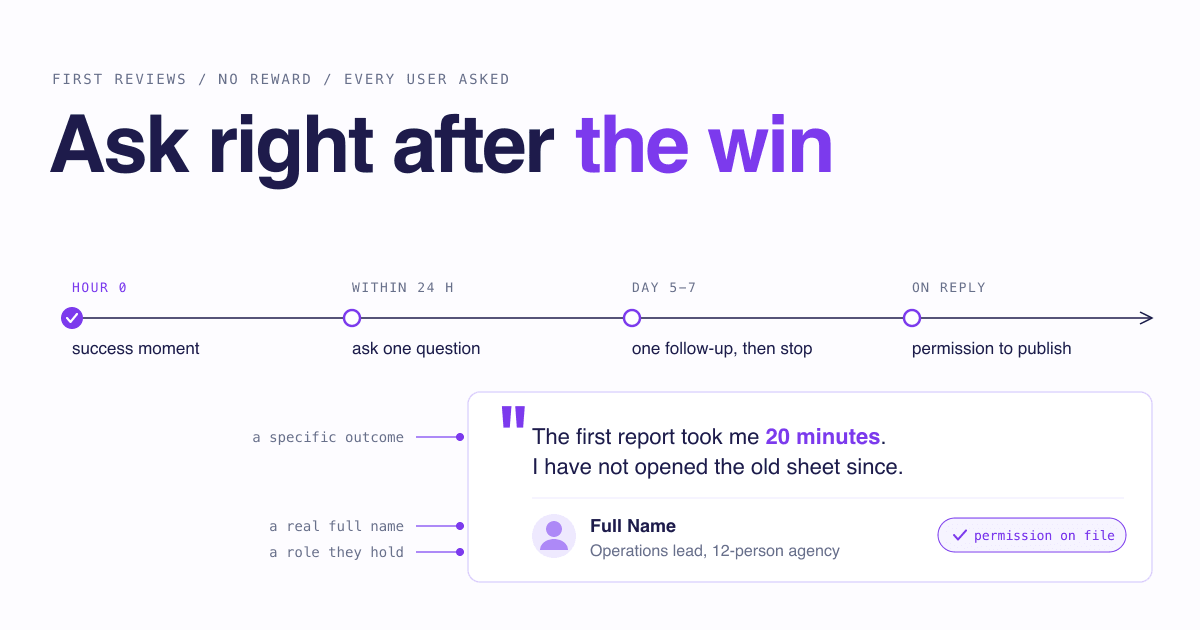
Send within 24 hours of the moment, from a personal address, to every user who reached it.
Subject: Quick question about [what they just did]

Hi [first name],

I saw you [sent your first invoice / finished your first export] with [product] yesterday. I am the founder, and I read every reply.

One question: what were you using before, and what is different now, if anything?

Two sentences is plenty. If something is broken or annoying, I would rather hear that than a compliment.

I am asking everyone who gets this far, and there is no reward attached either way.

[Your name]
[Role], [product]
What makes a testimonial believable?
A stranger believes a testimonial when it names a specific outcome and a specific person they could look up. In our view the five ingredients are outcome, full name, role, photo and permission.
Weak (invented example)
- "Amazing tool, highly recommend! Five stars." - Sarah K.
- No outcome: nothing the reader can picture or check.
- Initial instead of a surname, no role, no company, no photo.
- Could have been written by anyone, including you.
Strong (invented example)
- "We used to build the weekly report by hand in a spreadsheet. The first one from this took me 20 minutes, and I have not opened the old sheet since." - Full name, operations lead at a 12-person agency
- A before, an after and a number the customer chose themselves.
- Full name, role, company type, and a photo if they agree.
- Published with written permission and unchanged wording.
The call: Both examples are made up to show the difference in form. On your page, only real words from real users go inside quote marks.
Rules for editing and keeping a testimonial honest
- Shorten, never rewrite Cut a long reply if the meaning survives and the customer approves the result. Adding a claim they did not make makes it false.
- Do not imply a typical result you cannot prove If you lack proof that the endorser's experience represents what people will generally achieve, the FTC says the ad must make clear what the generally expected results are.[3]
- Disclose any connection next to the quote Free access, investor, adviser, friend: say so beside the quote. The FTC notes that knowing a reviewer got the product free "would probably affect the weight" readers give it.[3]
- Retire quotes from people who left If your site says or implies that the person still uses the product, the FTC says you can use the endorsement "only as long as you have good reason to believe the endorser does still use the product".[3] Checking once a year is our suggestion.
Email 2: permission to publish
Send after a user replies with something specific. Quote the exact words you want to use.
Subject: May I quote you?

Hi [first name],

Thank you for the reply. This part is exactly what other people in your position ask me about:

"[paste their exact words, shortened only by cutting]"

May I publish that on our website? I would show it as:

[Full name], [role], [company]
[with / without] your photo and a link to [their public profile]

Reply "yes" if that is fine, tell me what to change, or say no. All three are fine, and nothing about your account changes either way. You can ask me to take it down at any time.

[Your name]
Asking permission is our judgement, not a rule we found on the FTC pages. A name, an employer and a photo are personal details, and the person may need sign-off at work. Keep the "yes" email.
Where should your first reviews live: your site or a review platform?
Start with named testimonials on your own site, because you can do that with five users. Add one third-party platform when you have enough users to invite all of them the same way, and read its rules first, because they differ on incentives.
Figure 3Documented rules on who can review, asking and incentives, read on each first-party page in October 2026
| Where | Who may review | Asking for reviews | Incentives | Removing a review you dislike |
|---|---|---|---|---|
| Google reviews (Maps and Business Profile) | Who may reviewContent based on a conflict of interest is not allowed; that may include current or former employment.[8] | Asking for reviewsYou can ask customers with a link or QR code.[9] You may not discourage negative reviews or selectively solicit positive ones.[8] | IncentivesStrictly prohibited, including incentives to change or remove a negative review.[9] | Removing a review you dislikeYou can flag a review you believe violates the content policies.[9] |
| Trustpilot (guidelines for businesses v7.3, September 2026) | Who may reviewPeople over 18 with a recent, genuine experience; a purchase is not required. Not you, immediate family, anyone working for the business, or a competitor.[11] | Asking for reviewsInvite "consistently and fairly", which means inviting everyone in the same way. No picking which customers to invite.[11] | IncentivesNot allowed: "We don't allow incentivized reviews on Trustpilot."[11] | Removing a review you dislike"Not liking a star rating or disagreeing with a negative review is not a valid reason for flagging a review."[11] |
| G2 (community guidelines) | Who may reviewActual users, business partners or guest users. Not employees of the product's company or of a direct competitor.[12] | Asking for reviewsEncouraged. If G2 finds a seller soliciting only positive reviews, it removes the reviews.[12] | IncentivesAllowed with conditions: eligibility never depends on the opinion expressed, the review is labelled as incentivized, the value is capped at $100 USD, and sellers may not incentivize without disclosing it to G2.[12] | Removing a review you dislike"We do not edit or remove reviews at a seller's request." Sellers can respond publicly.[12] |
| Testimonials on your own website | Who may reviewReal customers. Officers, managers, employees and agents need a clear and conspicuous disclosure of the relationship.[1][2] | Asking for reviewsAllowed; generalized solicitations to purchasers are an explicit exception in the rule.[2] | IncentivesNot banned by the rule unless tied to sentiment; the FTC says the review should disclose the incentive.[2][4] | Removing a review you dislikeYou choose what to quote, but you are disseminating it and are liable if it is fake or false.[2] |
Figure 4Which kind of proof to collect first (our judgement)
Easy to check How checkable it is for a stranger, Low effort Effort to get with five users
Named quote on your siteStart here
Full name, role, photo, permission. One email each. Start here.
Easy to check How checkable it is for a stranger, High effort Effort to get with five users
Reviews on a third-party platform
Strong because you do not control it. Needs enough users to invite all of them.
Hard to check How checkable it is for a stranger, Low effort Effort to get with five users
Anonymous star rating
Easy to add, easy to ignore. Five stars from three unnamed people reads as nothing.
Hard to check How checkable it is for a stranger, High effort Effort to get with five users
Video testimonial or case study
Valuable later. Too much to ask in month one.
If you add star markup to your own pages, read Google's review snippet rules before you do. Ratings "must be sourced directly from users", the review content must be readily available on the marked-up page, and you may not aggregate reviews or ratings from other websites. If the entity being reviewed controls the reviews about itself, pages using LocalBusiness or any other Organization structured data are ineligible for the star review feature.[10] Hand-picked quotes are testimonials, not a rating; do not mark them up as one.
A directory listing is another place a review can sit outside your own domain. On SitePatent, a public listing page has a reviews section with an average rating, and logged-in members can upvote and reply to reviews. It stays empty until real users write in it, and everything in this guide applies there too. One fact to know: SitePatent has a points and tiers system for members, set out on its rewards page, and writing a review is one of the listed ways to earn points. See what each plan includes, or compare options in the audited directory comparison first.
What does the first 30 days of collecting proof look like?
Week one is setup, weeks two and three are asking and getting permission, and week four is publishing and deciding whether a platform is worth opening. It is a suggested schedule, not a measured benchmark.
A 30-day plan from zero public proof
Days 1-3
Define the moment and write the ask
Choose the success moment, adapt Email 1, and write your policy in one line: everyone who reaches the moment is asked, no reward, no edits beyond cutting.
Days 4-10
Ask every user who qualifies
Send Email 1 by hand. Log who was asked, when, and what they said, including the critical replies.
Days 11-17
Follow up once and request permission
Send Email 3 once to people who did not answer, and Email 2 to everyone who gave a specific answer. Fix what the critical replies point at.
Days 18-24
Publish the first named quotes
Put two to five approved quotes where the claim they support is made, not on a separate wall. Add name, role, photo and any disclosure beside each one.
Days 25-30
Decide on one platform
Pick the one platform your buyers already check, read its rules, and invite all users. With fewer than ten users, waiting is a reasonable call.
Email 3: the single follow-up
Send once, five to seven days after Email 1, only to people who did not reply. Then stop.
Subject: Re: Quick question about [what they just did]

Hi [first name],

One nudge and then I will leave you alone.

If it is easier than writing: which of these is closest?

A) It replaced something I was doing by hand
B) It replaced another tool
C) I am still deciding whether it is useful
D) It is not working for me

A one-letter reply is genuinely helpful, especially C or D.

[Your name]
First reviews checklist
0 of 12 done
Before you ask
Before you publish a quote
Before you open a platform profile
What should you do about a negative review, or no reviews at all?
Reply to a negative review in public, fix what is true in it, and never pay, pressure or threaten to make it disappear. If nobody is reviewing you yet, the fix is more real users, not invented ones.
What to do in the three awkward situations
If You have no users yet
Publish no testimonials. Show what is true instead: who built it, a demo, real screenshots, a changelog. Then get the first users; our guide to where to promote a startup covers the places. Invented quotes are exactly what the FTC rule targets.[1]
If You have users but they stay silent
Your ask is too big or too late. Move it closer to the success moment, cut it to one question, and send the one-letter follow-up. Do not add a reward where incentives are prohibited.[9][11]
If A negative review is accurate
Reply once, politely, with what you changed or will change. Google's own guidance says negative reviews "aren't necessarily a sign of poor business practices".[9] Do not ask the author to delete it: the FTC says asking customers to change or delete an initial negative review "could mislead readers".[3]
If A negative review breaks the platform's rules
Flag it through the platform with evidence. The FTC tells businesses not to misuse reporting tools "to get rid of honest, negative reviews".[4]
If You are tempted to bury it
Do not put all the 5-star reviews first or hold back only the negative ones. The FTC gives both as examples of presenting a misleading picture, noting that delaying only negative reviews "even just by a few days" could bias it.[3]
There is a contract angle too. Under the US Consumer Review Fairness Act, a company may not use a form contract provision that bars or restricts a customer's ability to review it, or that imposes a penalty or fee on someone who gives a review. You may still prohibit or remove a review that contains confidential or private information, is libelous, harassing, abusive or obscene, is unrelated to your products or services, or is clearly false or misleading.[7] If your terms contain a "no negative reviews" clause, delete it.
Which review tactics should you never use?
Anything that makes a reader believe a review came from an independent customer when it did not, or that hides the reviews you do not like. Each item below is taken from the FTC material, not from our taste.
Never do this
- Avoid: Write, generate or buy a review or testimonial That includes AI-generated ones and "placeholder" quotes.[1]
- Avoid: Reward a positive rating No discount, credit, gift card or upgrade that depends, openly or by implication, on what the review says.[1][3]
- Avoid: Let staff, founders or family pose as customers The FTC guidance is not to ask staff, family or friends for reviews "at least not without ensuring that they disclose" the connection in the review.[4]
- Avoid: Ask people who have not used the product "Don't ask for reviews from people who haven't used or experienced the product or service."[4] Review swaps with other founders usually fail this test.
- Avoid: Run a "neutral" comparison site that is yours You cannot misrepresent that a site you control provides independent reviews of a category that includes your product.[2]
- Avoid: Threaten a reviewer Unfounded legal threats, intimidation and certain false public accusations to remove a negative review are prohibited review suppression.[1]
- Avoid: Buy followers, views or other fake indicators Covered when you knew or should have known they were fake and used them for a commercial purpose.[1]
- Avoid: Hand the problem to an agency and stop looking The FTC warns that "you can be held responsible for what they do on your behalf", and that platforms could suspend or remove your accounts and listings.[4]
The honest version is slower, and that is the trade-off: five named quotes after a month looks thin next to a wall of stars. It is also the only version that survives a buyer who messages the person quoted. For ideas on presenting a young product, browse current listings on SitePatent.
6 quick answers
Common questions
Short answers to the follow-up questions readers ask most.
Not here? Ask usUnder the FTC rule, an incentive is not banned as long as there is no express or implied requirement that the review express a particular sentiment, and the FTC says the review should disclose the incentive. Platform rules are stricter and vary: Google and Trustpilot prohibit incentives entirely, while G2 allows them with labelling and a 100 US dollar cap. Offering nothing is simplest.
Sources
- [1]Federal Trade Commission Announces Final Rule Banning Fake Reviews and TestimonialsFederal Trade Commission, 2024
- [2]Consumer Reviews and Testimonials Rule: Questions and AnswersFederal Trade Commission, 2024
- [3]FTC's Endorsement Guides: What People Are AskingFederal Trade Commission, 2023
- [4]Soliciting and Paying for Online Reviews: A Guide for MarketersFederal Trade Commission, 2022
- [5]FTC Publishes Inflation-Adjusted Civil Penalty Amounts for 2025Federal Trade Commission, 2025
- [6]16 CFR 1.98 - Adjustment of civil monetary penalty amountsElectronic Code of Federal Regulations (eCFR)
- [7]Consumer Review Fairness Act: What Businesses Need to KnowFederal Trade Commission, 2017
- [8]Prohibited and restricted content - Maps user-generated content policyGoogle
- [9]Tips to get more reviews - Google Business Profile HelpGoogle
- [10]Review snippet (Review, AggregateRating) structured dataGoogle Search Central
- [11]Guidelines for Businesses (version 7.3)Trustpilot, 2026
- [12]G2 Community GuidelinesG2
- [13]Online Shopping and E-Commerce: Online reviewsPew Research Center, 2016
- [14]Online Shopping and E-Commerce: MethodologyPew Research Center, 2016
- [15]How Online Reviews Influence SalesSpiegel Research Center, Northwestern University, 2025
How this guide was put together. We checked every FTC, Google, Trustpilot and G2 rule and quotation here against the text of the cited page on October 11, 2026 (FTC pages as Internet Archive copies of the originals) and report them as written on that date; policies and penalty amounts change, so re-read them before you act. The only statistics used come from a Pew Research Center survey fielded in late 2015 with a published methodology, plus one Spiegel Research Center finding first published in 2017 whose method we could not inspect; both describe consumers, not software buyers. The request templates, the 30-day schedule, the matrix and the weak and strong examples are editorial judgement and invented illustrations, not findings, and nothing here is legal advice.