On today's numbers, more than half of the WordPress sites that report their PHP version will be running one without security fixes on 1 January 2027. That is the surest of seven changes heading for small business websites next year, and none of them is a guess about fashion: each one is read off a date or a measurement that PHP, Chrome, the certificate authorities or Google have already published. Below, each forecast says how sure it is, what your site will feel, and what to do before it lands.
The 2027 outlook at a glance
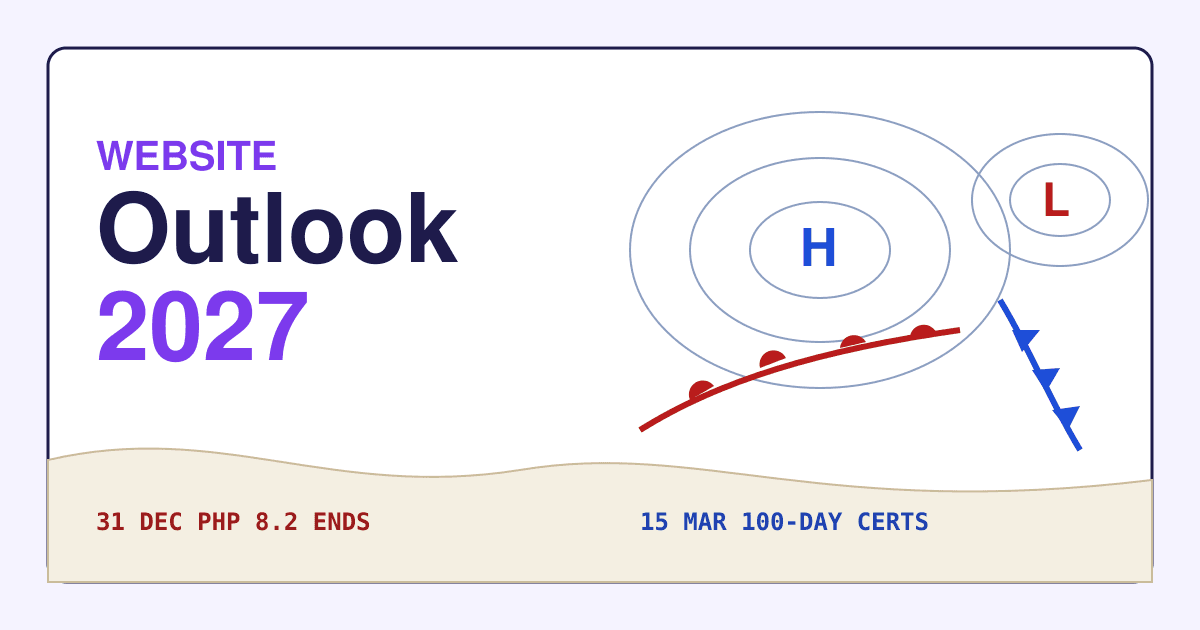
- 31 Dec 2026 PHP 8.2 loses security fixes Fixed date
- Rolling out now Chrome asks before HTTP pages Announced
- Jan 2027 Gmail stops fetching other mailboxes Fixed date
- 10 Feb + 15 Mar 2027 Certificates renew more often Fixed date
- All year Fewer clicks from Google answers Trend
- All year No cookie cliff in Chrome Announced
- All year Fewer rich result types Trend
How sure each forecast is
- Fixed date
- The owner of the change has published the day or the month. It will happen unless they reverse it.
- Announced
- A published plan from the company that controls it. The direction is settled; the exact timing can move.
- Trend
- A measured direction with no date attached. We expect it to continue through 2027; that reading is ours.
Dates and figures come from the sources at the foot of the page, checked on 12 November 2026. Where a card says what your site will feel, that is our forecast, not the source's.
Before the year turns, check three things: your PHP version (move to 8.4 or 8.5), whether any business mailbox is read in Gmail through "Check mail from other accounts", and whether your certificate renews by itself. Then make sure every address you have ever printed opens on HTTPS. The rest of 2027 is trends to watch in Search Console, not deadlines.
Seven forecasts for 2027
PHP 8.2 loses its last security fixes
Fixed date- When
- 31 December 2026
- The signal
- PHP's own table lists 31 December 2026 as the end of security support for 8.2; 8.3 follows on 31 December 2027, 8.4 on 31 December 2028 and 8.5 on 31 December 2029 (php.net). WordPress.org's version counter, read on 12 November 2026, shows 22.5% of reporting sites on 8.2 and 32.1% on 8.1 or older, which is already out of support (WordPress.org stats).
- What your site feels
- Nothing breaks on 1 January by itself; the version simply stops getting fixes. We expect hosts to move sites up during 2027 or keep old versions only on legacy plans. When that happens, the usual casualty is an old plugin or theme that was never updated for a newer PHP.
- Pack for it
- In WordPress open Tools, then Site Health, then the Info tab and Server: it shows the PHP version the site runs (WordPress documentation). Move to 8.4 or 8.5 rather than 8.3, which only buys one year. Take a backup and try the switch on a staging copy first; our restore drill shows how to prove the backup works.
Chrome asks before opening a page without HTTPS
Announced- When
- Chrome 147 for Enhanced Safe Browsing users, then Chrome 154 for everyone
- The signal
- Google wrote in October 2025 that with Chrome 154 it would turn on "Always Use Secure Connections" by default, so that "Chrome will ask for the user's permission before the first access to any public site without HTTPS" (Chrome Security blog). Chromium's release calendar lists Chrome 147 as stable on 7 April 2026 and Chrome 154 on 22 September 2026 (Chromium Dash). Google measured that the median user sees fewer than one such warning a week.
- What your site feels
- A site that answers on HTTPS at every address sees nothing: Chrome tries HTTPS first and goes straight there. The warning lands on the address you forgot: a bare name without a certificate, an old shop. or booking. subdomain, or a host printed on a flyer years ago. And it shows to first-time visitors, the ones a small business most wants to keep.
- Pack for it
- Open http:// and https:// for the bare name, the www name and every subdomain you have ever printed or shared. Each must end on an https:// page with no warning. The commands further down do the same check in seconds.
Gmail stops fetching mail from your other mailbox
Fixed date- When
- January 2027 for existing users (new users lost it after the first quarter of 2026)
- The signal
- Google's Gmail Help says "Gmail will no longer support checking emails from third-party accounts through POP" and that "existing users can still use the feature until January 2027". Gmailify, which adds Gmail's spam filter to another account, goes too (Gmail Help).
- What your site feels
- A common setup: the business address at your own domain lives in a mailbox at the web host, and you read it inside personal Gmail through "Check mail from other accounts". When the fetch stops, enquiries pile up in a mailbox nobody opens, and nothing tells you.
- Pack for it
- In Gmail on a computer open Settings, See all settings, Accounts and Import, and look under "Check mail from other accounts". If an address is listed, either set up forwarding at the host (Google's first suggestion) or add the account to the Gmail phone app, which uses IMAP. Then send a test message from an outside address and confirm it arrives.
HTTPS certificates renew more often
Fixed date- When
- 10 February 2027 (Let's Encrypt) and 15 March 2027 (every public certificate authority)
- The signal
- Under CA/Browser Forum ballot SC-081v3, passed with 25 issuers and all four browser makers voting yes, a public certificate issued from 15 March 2027 may last at most 100 days (CA/Browser Forum). Let's Encrypt moves its default to 64-day certificates on 10 February 2027, with a 10-day window for reusing a domain check, and to 45 days in February 2028 (Let's Encrypt).
- What your site feels
- A certificate installed by hand once a year will need installing at least four times a year from mid-March. Automatic renewal keeps working, but Let's Encrypt warns that "renewing at a hardcoded interval of 60 days will no longer be sufficient" once certificates last 45 days. The full renewal plan is in our post on 200, 100 and 47-day certificates.
- Pack for it
- Ask your host whether renewal is automatic, and if it is, add an outside expiry monitor that emails you. If you install certificates by hand, switch to automatic renewal before 15 March 2027.
Fewer clicks from Google when it answers the question itself
Trend- When
- All of 2027
- The signal
- Pew Research tracked 68,879 real Google searches by 900 US adults in March 2025. When an AI summary appeared, people clicked a regular result on 8% of visits against 15% without one; they clicked a link inside the summary on 1%, and ended their browsing on 26% against 16%. Summaries showed on 8% of one- or two-word searches, 53% of searches of ten words or more and 60% of searches starting with who, what, when or why (Pew Research Center).
- What your site feels
- Our reading: the pages that lose first are the ones that answer questions, such as "how much does a bathroom refit cost" or "what is a retainer". Short searches for your name, your trade and your town show summaries far less often, so they should hold up better.
- Pack for it
- In Search Console open Performance, compare clicks and impressions for the last three months with the same months a year earlier, and filter queries containing what, how or cost. Put the price range, area served and booking or call link on those pages, so the visitor who does click can act at once.
No cookie cliff in Chrome
Announced- When
- All of 2027
- The signal
- In October 2025 Google confirmed that Chrome "will maintain our current approach to offering users third-party cookie choice" and retired most of the Privacy Sandbox replacements, including the Attribution Reporting API, Protected Audience and IP Protection (Privacy Sandbox blog).
- What your site feels
- The third-party cookie shutdown that was promised for years is off in Chrome, so embedded widgets and ad tags behave in 2027 much as they did in 2026. Nothing in Google's change touches the consent rules your cookie banner follows: the banner stays.
- Pack for it
- Do not pay for a "cookieless rebuild" sold on a 2027 Chrome deadline; there is none. Keep the consent setup you have and review it when you add a new tag.
Google shows fewer kinds of rich result
Trend- When
- All of 2027
- The signal
- In June 2025 Google phased out seven structured data displays (Book Actions, Course Info, Claim Review, Estimated Salary, Learning Video, Special Announcement and Vehicle Listing), removed six of them from Search Console reports and the Rich Results Test on 9 September 2025, and said it will "keep looking for ways to simplify the Search results page" (Google Search Central).
- What your site feels
- Google says the change does not affect ranking. Markup added only to win a display that is gone simply does nothing in Google Search. We expect more types to follow in 2027.
- Pack for it
- Compare the markup on your pages with Google's current search gallery. Keep types that are on the list and describe what the page visibly shows; drop paid add-ons built around a dropped type.
Check your own site in four commands
Replace example.com with your domain and run these in a terminal; repeat the first two for www. and each subdomain.
# 1. Does the plain address end on HTTPS? Look for a 301 or 308 to https://
curl -sI http://example.com | grep -iE "^(HTTP|location)"

# 2. Does the HTTPS address answer with 200?
curl -sI https://example.com | head -1

# 3. When was the certificate issued, and when does it expire?
echo | openssl s_client -connect example.com:443 -servername example.com 2>/dev/null | openssl x509 -noout -startdate -enddate

# 4. Which PHP version does the server run? (over SSH on the host)
php -v
The command line can run a different PHP version from the site itself; the Site Health screen shows the one the site uses.
What to do, month by month
- Before 31 Dec 2026Move PHP to 8.4 or 8.5 on a staging copy, then on the live site.
- Before January 2027Replace any "Check mail from other accounts" fetch with forwarding or IMAP, and send a test message.
- Before 10 Feb 2027Confirm automatic certificate renewal and add an outside expiry monitor.
- Before 15 Mar 2027Switch any hand-installed certificate to automatic renewal.
- Any weekOpen every address you have printed over http:// and https:// and fix the ones that warn.
- Each quarter of 2027Compare Search Console clicks for question searches year on year, and check your markup against Google's list.
Questions about the 2027 outlook
Why no design or AI trends in this forecast?
Because they have no date and no owner who has published one. Every card here rests on a calendar or a measurement that someone outside this page has put on record, so you can check it.
Which of these can take my site offline?
A lapsed certificate, which shows visitors a full-page warning, and a forced PHP upgrade that an old plugin cannot survive. The other five change how many people arrive or what they see, not whether the site loads.
Does any of this apply if my site is on a hosted builder?
Partly. A hosted builder runs the server, so PHP and certificate renewal on its own domains are its job. The Gmail change, HTTPS on any subdomain you point elsewhere, Search clicks and markup are still yours.
Will PHP 8.2 stop working on 1 January?
No. It keeps running; it just gets no more security fixes from the PHP project. The risk grows with every flaw found after that date.
Sources
- PHP: Supported Versions
- WordPress.org PHP version statistics, read 12 November 2026
- WordPress documentation: Site Health screen
- Chrome Security blog: HTTPS by default (28 October 2025)
- Chromium Dash release schedule, Chrome 147 and 154
- CA/Browser Forum: Ballot SC-081v3, reducing validity and data reuse periods
- Let's Encrypt: Decreasing certificate lifetimes to 45 days (2 December 2025)
- Gmail Help: upcoming changes to Gmailify and POP in Gmail
- Pew Research Center: Google users are less likely to click on links when an AI summary appears (22 July 2025)
- Privacy Sandbox: Update on plans for Privacy Sandbox technologies (17 October 2025)
- Google Search Central blog: Simplifying the search results page (12 June 2025, updated 8 September 2025)
- Google Search Central: structured data search gallery
Dates and figures checked on 12 November 2026. Plans can move; the source pages carry any change first.