We use analytics cookies to see how the site is used. They are only set if you accept. Accepting also turns on session recording (pages viewed, clicks and scrolls) so we can fix problems; what you type stays hidden. Read the privacy policy
What It Costs to Run a Website Per Year: 4 Real Bills, Line by Line
A website costs about $190 to $1,500 a year to run, or $2,844 for a small store. Four renewal-year bills, line by line, with the costs no invoice shows.
By SitePatent Editorial TeamPublished Reviewed
Current reading, Bill 2
1,000s
100s
10s
1s
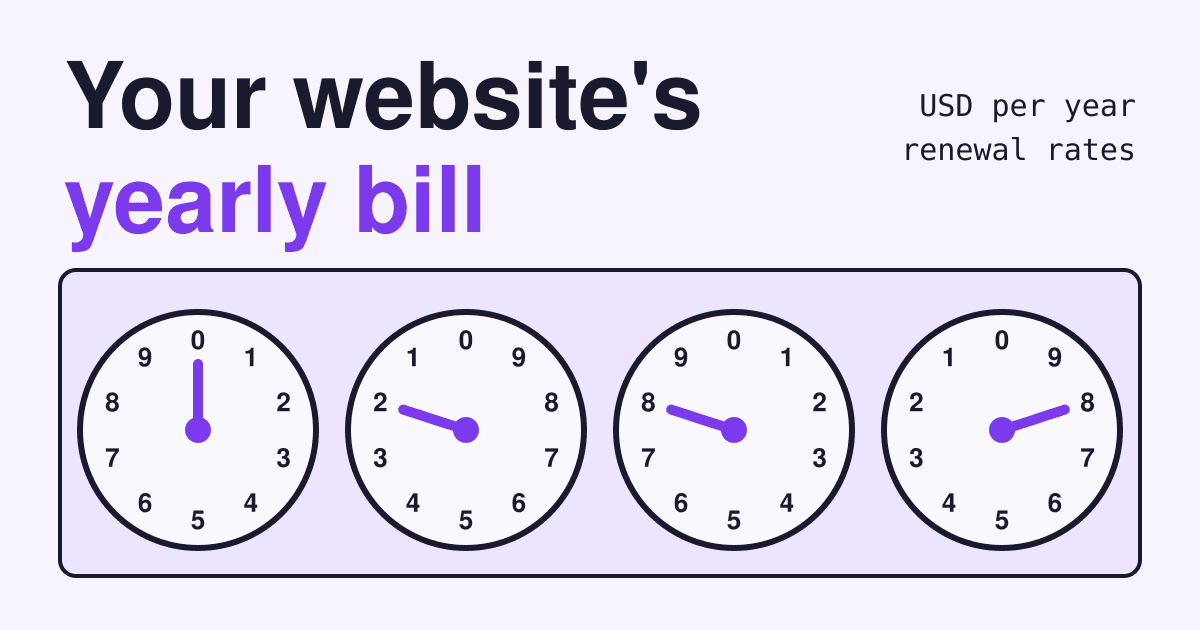
Amount due$288 a year
What does it cost to run a website per year?
On November 1, 2026 the wholesale price of a .com name rose 71 cents, and on a small business website's yearly bill that change is almost impossible to find.
The bill itself is simple to state. A small business website costs about $190 to $1,500 a year to run in cash, before your own time. A site on a hosted builder sits near $192. WordPress you look after yourself comes to about $288, and the same WordPress site with a paid care plan comes to about $1,488. A small online store with $60,000 in sales runs about $2,844, and $2,040 of that is card fees.
These are renewal-year prices, not sign-up prices. All four bills are in US dollars, before tax, using prices on the providers' own pages or reported from them on November 1, 2026.
Bill 1, builder site$192
Bill 2, WordPress, your upkeep$288
Bill 3, WordPress, care plan$1,488
Bill 4, small store$2,844
The four bills, line by line
Each bill has one .com domain and one business mailbox, so the bills can be compared fairly. The company names show a real price point. They are not recommendations, and a competitor at the same price would give the same total.
Bill 1: the builder site
A brochure site on a hosted builder. The platform handles hosting, updates and backups.
Line
Per year
Builder planWordPress.com Premium, $8 a month billed yearly
$96
.com domainClose to the $11.17 cost floor; free in year one on many plans
$12
One business mailboxGoogle Workspace Business Starter, $7 a month on a yearly plan
$84
Cash due in a renewal year
$192
Bill 2: WordPress you run yourself
Free software on rented hosting. You do the updates and check the backups.
Line
Per year
HostingHostinger Premium at its $10.99 a month renewal rate
$131.88
.com domainClose to the $11.17 cost floor; free in year one on many plans
$12
One business mailboxGoogle Workspace Business Starter, $7 a month on a yearly plan
$84
One paid pluginOur assumption: a one-site premium plugin licence at about $5 a month
$60
Cash due in a renewal year
$288
Bill 3: WordPress with a care plan
The same site, with a company paid to update, back up and fix it.
Line
Per year
HostingHostinger Premium at its $10.99 a month renewal rate
$131.88
.com domainClose to the $11.17 cost floor; free in year one on many plans
$12
One business mailboxGoogle Workspace Business Starter, $7 a month on a yearly plan
$84
One paid pluginOur assumption: a one-site premium plugin licence at about $5 a month
$60
Care plan$100 a month, the low end of Codeable's range for a small business site
$1,200
Cash due in a renewal year
$1,488
Bill 4: the small online store
A shop with 1,000 orders a year at $60 each, so $60,000 in sales.
Line
Per year
Store planShopify Basic, $29 a month billed yearly
$348
.com domainClose to the $11.17 cost floor; free in year one on many plans
$12
One business mailboxGoogle Workspace Business Starter, $7 a month on a yearly plan
$84
Two paid appsOur assumption: $15 a month each
$360
Card fees2.9% + 30 cents per order, so $1,740 + $300
The biggest line is different on every bill, and on none of them is it the domain name. On the builder site, half the bill is the platform and 44% is email. Add a care plan and it takes 81% of the bill. On the store, card fees take 72%, and they grow with every sale while everything else stays put.
Bill 1$192Platform 50%, Email 44%, Domain 6%
Bill 2$288Hosting 46%, Email 29%, Plugin 21%, Domain 4%
Bill 3$1,488Care plan 81%, Hosting 9%, Email 6%, Plugin 4%, Domain 1%
Platform or hostingEmailPlugins and appsDomainCare planCard fees
Share of each renewal-year bill by line, from the four bills above.
So the .com rise is worth keeping in proportion: 71 cents is 0.37% of Bill 1 and 0.02% of Bill 4. Verisign can raise the price again, up to 7% a year in four of every six years under its current contract, and it would still not be the line to worry about.
Why the renewal bill is bigger than the first one
Most comparison pages quote the rate you pay on day one. You budget against the rate you pay after that, and the gap can be four times the headline price.
Take Bill 2. In its first year the cash cost is about $174: $29.88 of hosting, a free domain, $84 of email and $60 for the plugin. At renewal rates the same site costs $288, which is 66% more for nothing new.
Watch the long term. The 48-month hosting deal holds the low rate for four years, which is why it looks painless. Then the next 48 months cost $527.52 instead of $119.52. Put the renewal date in your calendar on the day you buy.
What the bill leaves out
Three costs never arrive on an invoice from your website, and each one can outweigh the lines above.
Your own hours
Updates, broken forms and content changes take time. The hours below are our estimates, not measurements, so put in your own. We priced them at $45 an hour, close to the hourly equivalent of the $92,650 median yearly wage for US web developers.
Bill
Hours a year
Time
Cash + time
1, builder
4
$180
$372
2, WordPress, your upkeep
12
$540
$828
3, WordPress, care plan
2
$90
$1,578
4, small store
24
$1,080
$3,924
The table shows what a care plan really buys. At $100 a month it costs $1,200 and saves about 10 hours, so you pay $120 for each hour you get back. Automated update services start near $39 a month, which is $468 a year, or about $47 an hour if one saved you the same 10 hours. A care plan makes sense when the site earns money and an outage costs more than the plan, not because the hours are cheaper.
Tax
Plan prices usually exclude it. Google's pricing page says so outright. If your business cannot reclaim VAT or sales tax, add your local rate to the plan prices above.
The next redesign
A site is rebuilt eventually, so set money aside for it. Divide the cost of the build by the years you expect it to last. A $5,000 site you plan to keep for five years adds $1,000 a year, which is more than Bills 1 and 2 put together.
Six ways to cut the bill
Saves $120
Pay yearly, not monthly
WordPress.com Premium is $18 billed monthly and $8 billed yearly, so $216 becomes $96.
Saves up to $84 in year one
Use the mailbox your host includes
Hostinger includes two mailboxes per site, free for the first year, so check what they cost at renewal. It suits a one-person business that does not need the rest of a full office suite.
Saves up to $60
Delete paid plugins with no clear job
Before each licence renews, ask what breaks without it. If you cannot say, try the site without it.
Saves up to $11.82
Move the domain to an at-cost registrar
Cloudflare Registrar says it charges the registry and ICANN price with no markup. That is about $11.17 against the $22.99 reported at GoDaddy. Read what happens when a domain lapses first, and never let a transfer run into your expiry date.
The gap between $527.52 and $119.52 on the plan in Bill 2 is $408 over four years. A month before the term ends, compare your renewal quote with new-customer prices elsewhere, then ask for a better rate or plan a move while you have time to test it.
Website running costs: common questions
How much does a small business website cost per month?
About $16 for a builder site, $24 for self-run WordPress and $124 with a $100 care plan, once you divide the renewal-year bills by 12. A small store with $60,000 in sales is about $237 a month with card fees and $67 without.
Can I run a website for free?
You can publish one for free on a builder's subdomain, but it is not a business address, and free WordPress.com sites show ads to visitors. For your own domain, expect to pay at least the $11.17 cost floor of a .com each year.
It is the only way to fix today's price, and the limit is 10 years on names such as .com. With rises of under a dollar a year, the stronger reason is that you cannot forget a renewal you have already paid.
What happens if I stop paying?
The lines fail one at a time. A lapsed domain takes the site and email offline, a lapsed host takes the site offline, and a lapsed licence usually stops updates while the site keeps working. Our uptime guide covers what you can claim when a paid host goes down.
Sources
Prices were read on November 1, 2026 unless marked. Some pricing pages change by country, and they do not always show US dollars. Where that happened, the US figure comes from a dated report, named below.